
Deconstructing the Two-Wheeler Value Chain
Mapping the Engine to the Ancillaries:

The two-wheeler (2W) industry operates on a highly segmented value chain, encompassing sixteen distinct subsystems that define everything from structural integrity to advanced electronic controls. An analytical breakdown reveals specialized component mapping and highlights the dominance of key Indian ancillaries that serve both traditional internal combustion engine (ICE) models and emerging electric vehicle (EV) platforms.
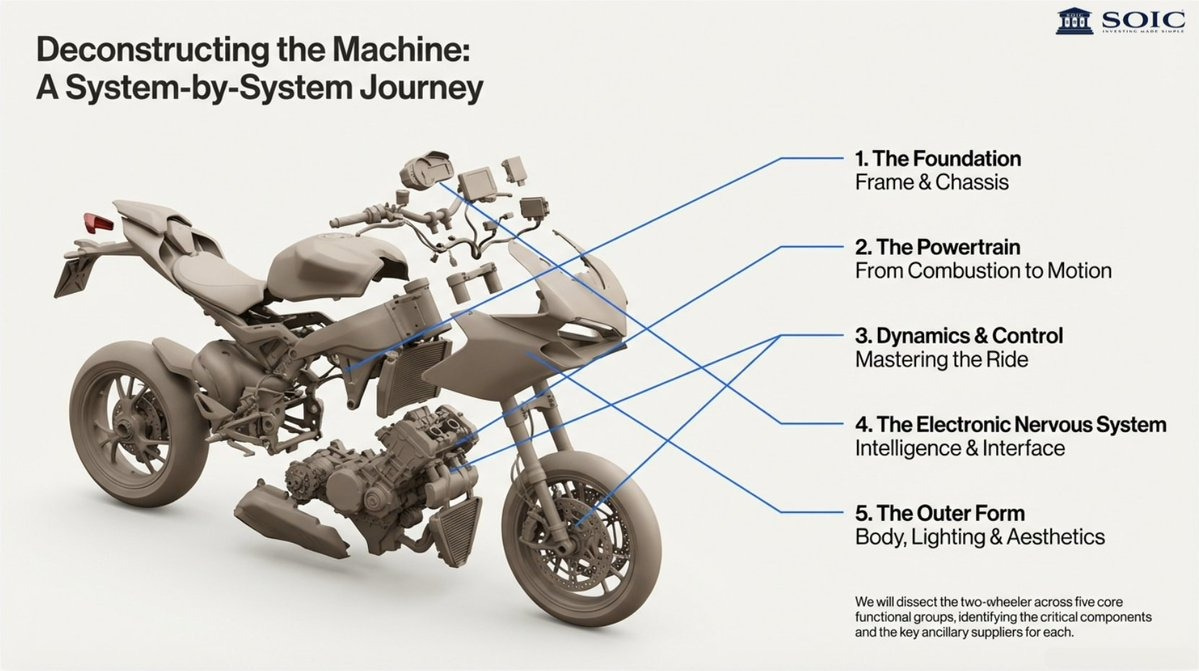
1) Core Structure and Engine Components
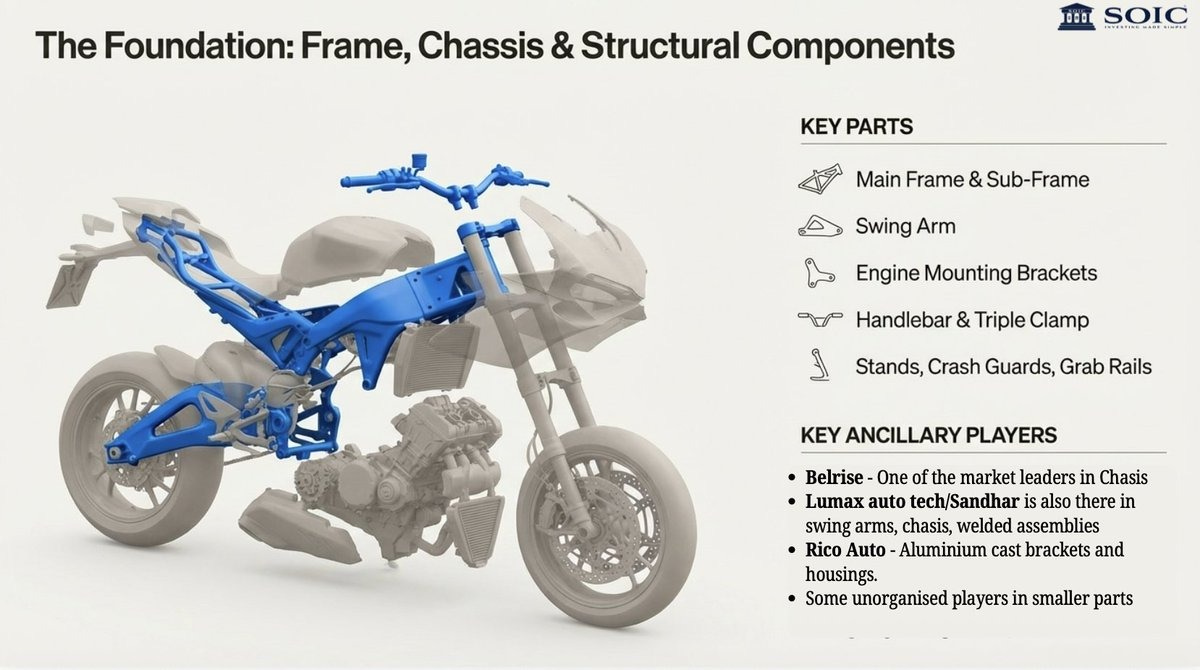
The foundation of any 2W is the Frame & Chassis, which includes the main frame, swing arm, handlebar, and engine mounting brackets. Key players here include Belrise, Lumax Auto Technologies, Sandhar which focuses on chassis parts and welded assemblies, and Rico Auto, supplying aluminium cast brackets.
The Engine Core itself is complex, covering crankcase halves, cylinder heads, and the crank-train (crankshaft, camshaft). Expertise in high-precision aluminium casting is essential. Alicon Castalloy provides aluminium cylinder heads, blocks, and crankcases, while Endurance Technologies is critical for aluminium die-cast engine housings and structural castings. Rico Auto Industries also plays a significant role, supplying high-pressure aluminium castings, including oil pump housings, often to Hero MotoCorp.
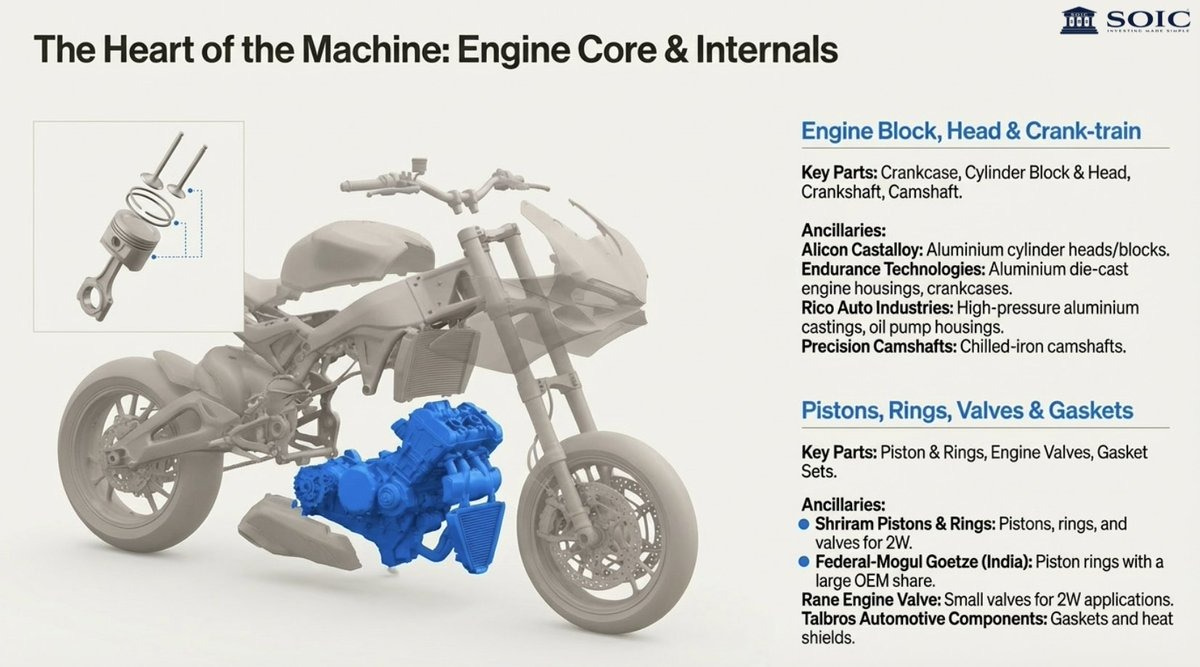
The reciprocating mechanism - Pistons, Rings, Valves & Gaskets - is handled by specialists. Shriram Pistons & Rings and Federal-Mogul Goetze (India) are leading suppliers of pistons and rings for two-wheelers. Rane Engine Valve focuses specifically on small valves and valve-train components tailored for 2W applications
2) Power Delivery and Dynamics
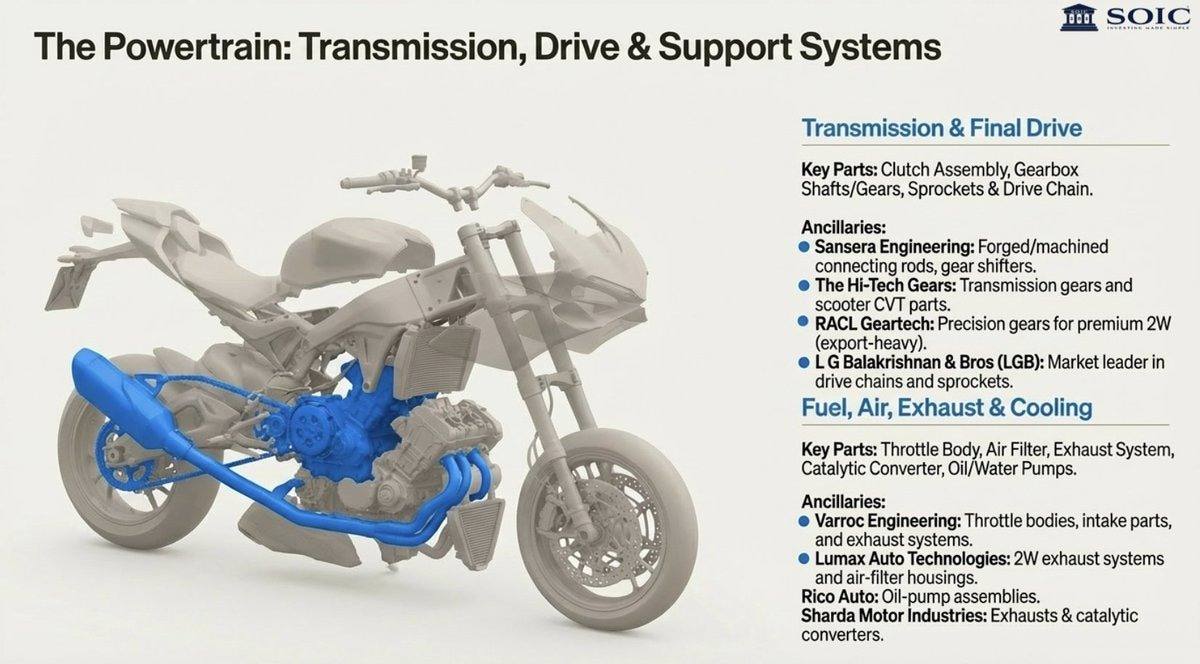
The Transmission & Final Drive ensures power reaches the wheel, involving the clutch assembly, gearbox shafts/gears, sprockets, and the drive chain. Sansera Engineering provides critical forged and machined components like connecting rods and gear shifters. For the final drive, L G Balakrishnan & Bros (LGB) is essential, supplying complete drive and timing chain kits and sprockets. Furthermore, precision gear manufacturers like The Hi-Tech Gears and RACL Geartech (Often export-heavy, focusing on premium motorcycles) supply transmission components.
In the crucial area of dynamic control, the suspension system features telescopic/USD front forks and rear shock absorbers. Endurance Technologies is identified as the market leader in 2W suspension, supplying front forks and mono-shocks. Gabriel India and Munjal Showa are also strong suppliers of shock absorbers, the latter having robust ties with OEMs like Hero and Honda.
Braking Systems are diversifying, moving from traditional drum brakes to disc rotors, calipers, and advanced ABS modulators for premium bikes. ASK Automotive is a leader in 2W brake shoes, disc pads, and ABS-ready components. Endurance Technologies also supplies disc brakes and integrated braking systems.
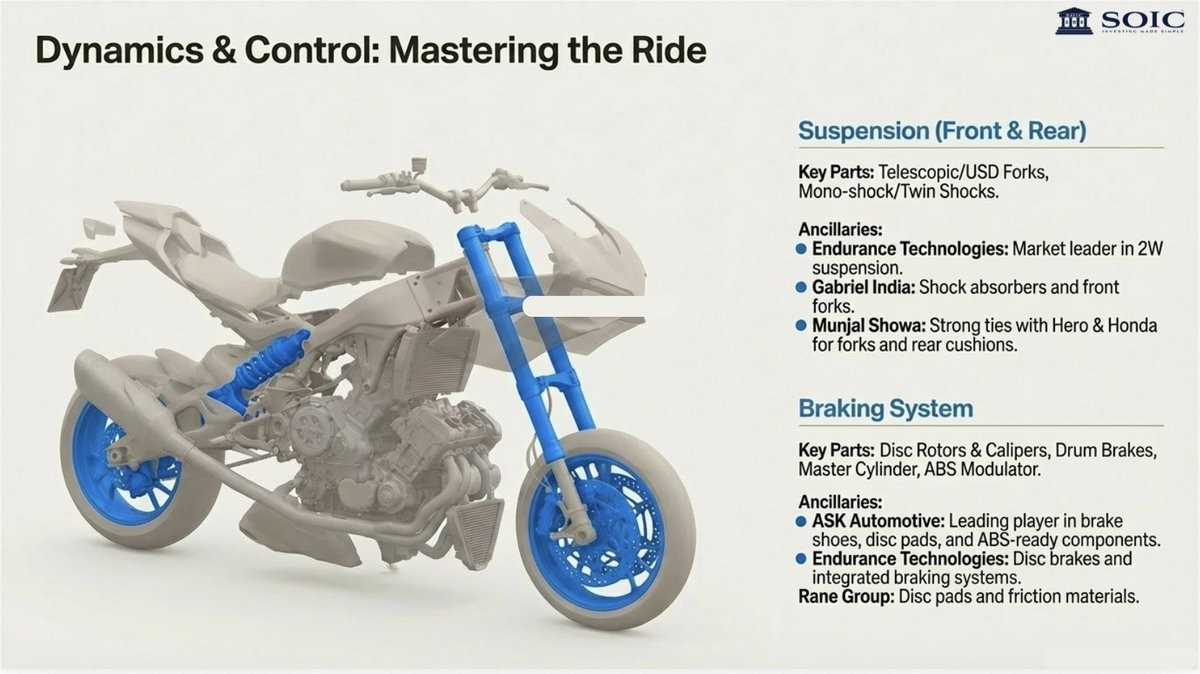
For Wheels & Tyres, suppliers are segmented by material. Steel rims are provided by Steel Strips Wheels and Munjal Auto Industries, while alloy wheels are sourced from Enkei Wheels India and joint ventures like Rico (Jinfei-Rico JV). The tyre segment is dominated by major players such as MRF, CEAT, and TVS Srichakra / TVS Eurogrip.
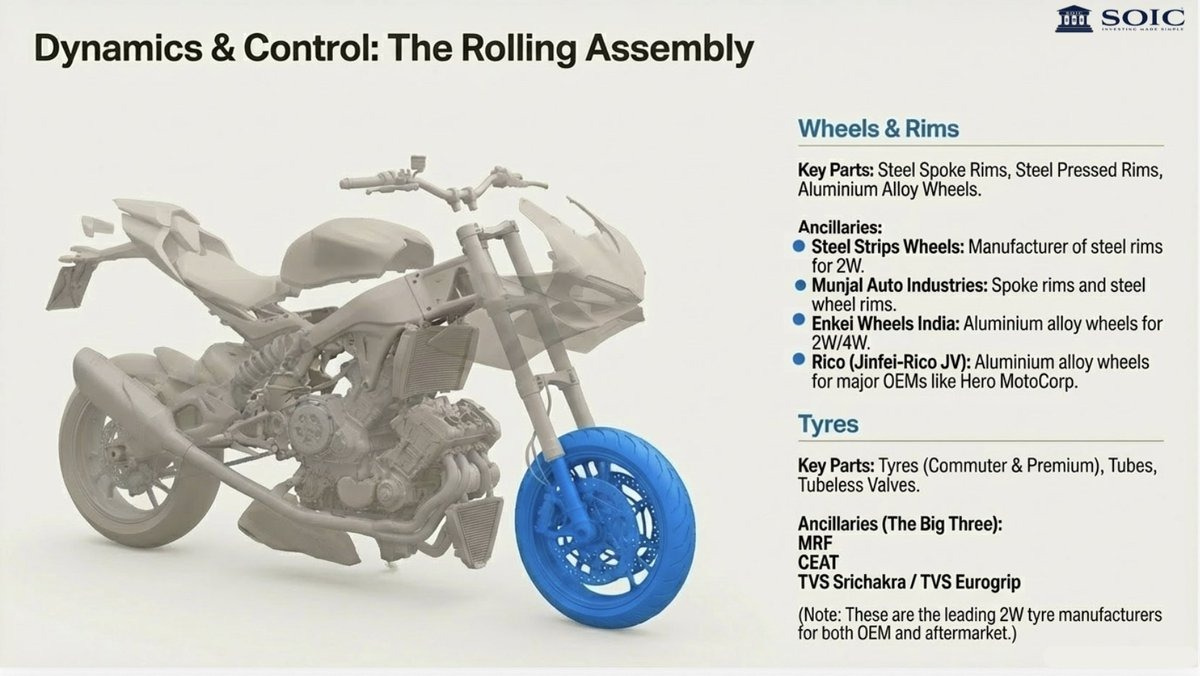
3) Electronics, Controls, and Aesthetics
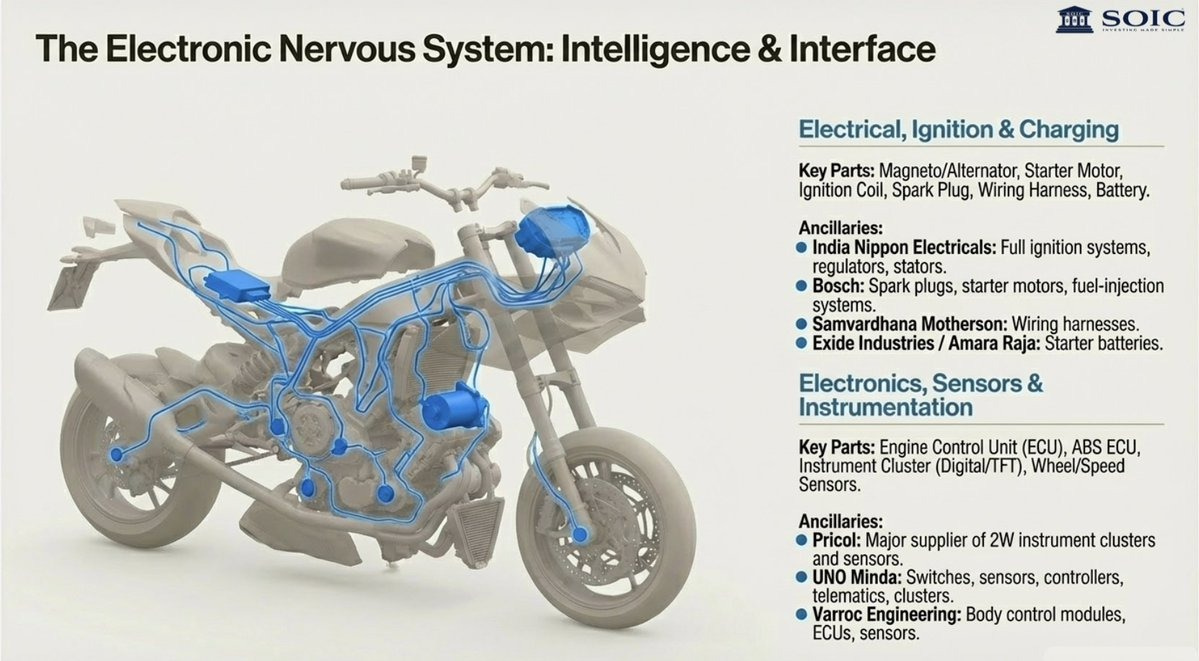
The modern two-wheeler increasingly relies on complex electronics. The Electrical & Ignition / Charging system includes the alternator, regulator–rectifier, and starter motor. India Nippon Electricals supplies full ignition systems and related electronics, while Bosch provides core components like spark plugs and starter motors. Wiring harnesses, which tie the electrical system together, are often supplied by Samvardhana Motherson.
For Electronics, Sensors & Instrumentation, the shift is towards digital clusters, ECUs, and connectivity. Pricol is a major supplier of instrument clusters and sensors. UNO Minda (Minda Industries) delivers a wide array of products, including switches, telematics, and instrument clusters.
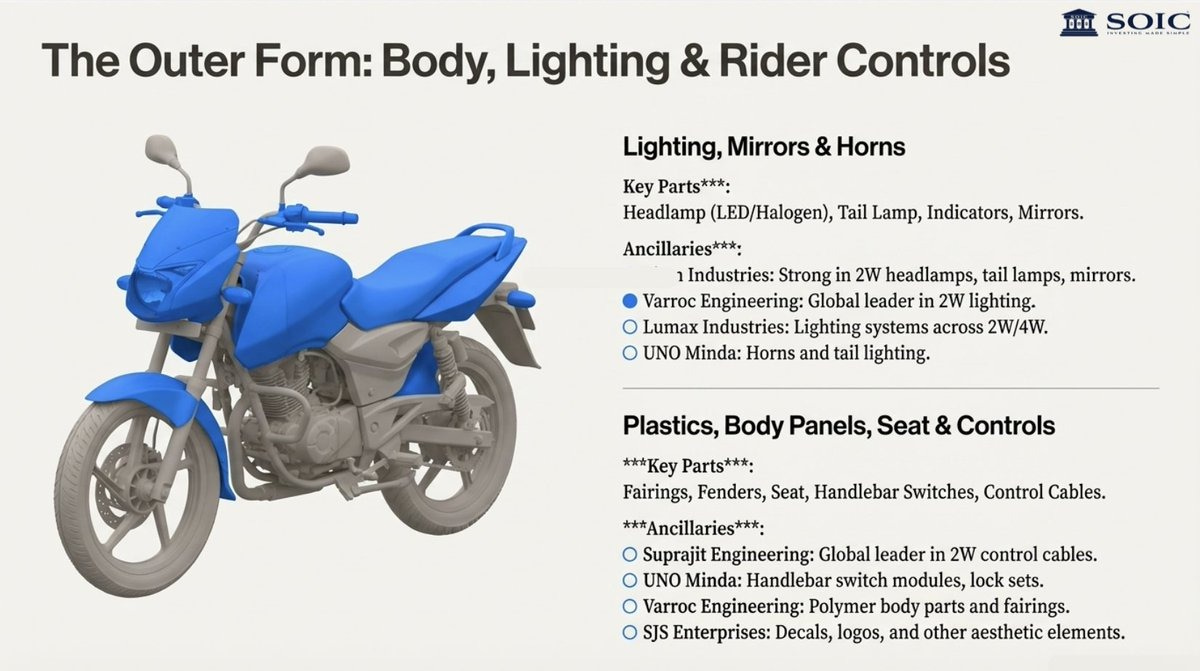
In the Lighting, Mirrors & Horns segment, Varroc Engineering is noted as a global 2W lighting leader, alongside strong domestic presence from Fiem Industries and Lumax Industries. For Cables, Controls & Switchgear, Suprajit Engineering is recognised as a global leader in 2W control cables (throttle, clutch, brake, etc.), complementing UNO Minda’s supply of handlebar switch modules and lock sets.
Finally, Plastics, Body Panels, Seat & Luggage define the vehicle’s aesthetics and utility. Varroc Engineering and Lumax Auto Technologies are key suppliers of polymer body parts and fairings. Aesthetic components like decals, logos, and cover displays are supplied by SJS.
IV. The EV Pivot: A New Value Stream
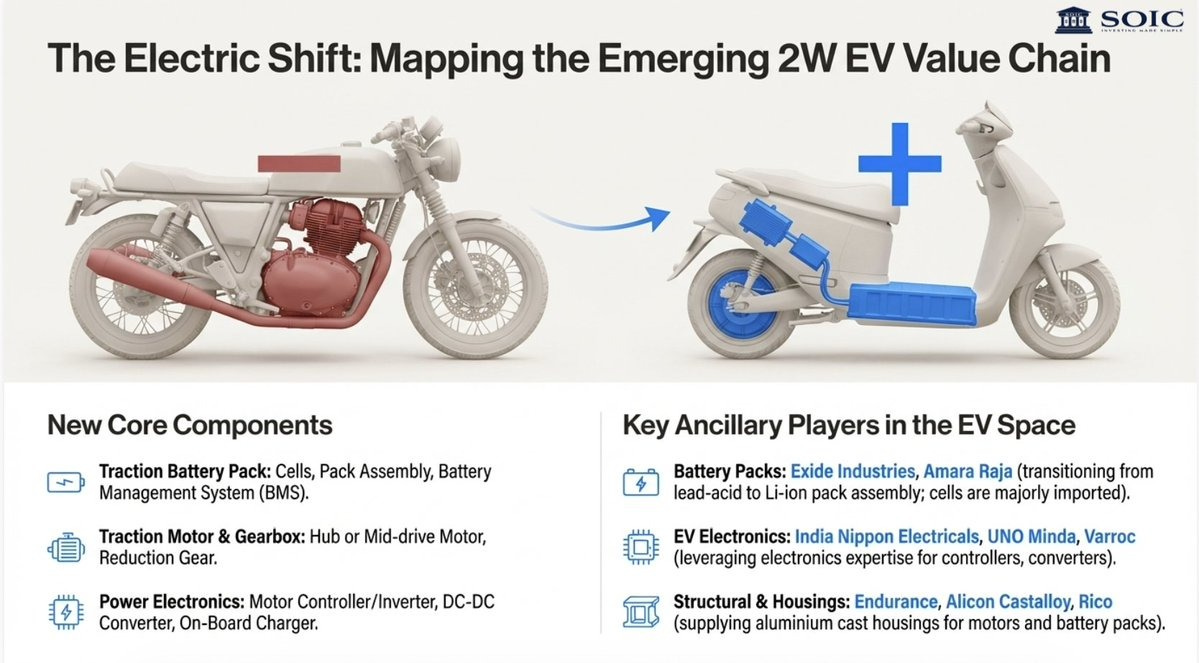
The emerging Electric Two-Wheeler (e-2W) segment introduces a crucial new module. The 2W EV-Specific Module requires lithium-ion traction battery packs (often imported), traction motors, and complex controllers/inverters.
Few of the suppliers are rapidly integrating EV capabilities:
Exide Industries and Amara Raja are supplying lithium-ion packs and modules.
India Nippon Electricals, UNO Minda, and Varroc are adapting to provide necessary EV electronics, controllers, and DC-DC converters.
Traditional metal casters like Endurance, Alicon, and Rico are leveraging their expertise to supply aluminium cast housings and structural parts required for the new EV powertrains.
The complexity of the 2W value chain means many specialized ancillaries, such as Sansera, RACL, and Hi-Tech Gears, often contribute across multiple buckets, acting as suppliers for forgings, fasteners, and precision machined components used in both engines and transmissions. This interconnected ecosystem underscores the depth of expertise within the two-wheeler component sector. The 2W value chain, when viewed as a whole, is like a massive, finely tuned clock, where specialized cogs (ancillaries) must work perfectly to ensure the movement of the larger mechanism (the OEM).
Disclaimer - Nothing in this is a buy/sell recommendation and is only for educational purposes
Thanks
Very well explained