
The CTC Bottleneck
Inside India's Copper Winding-Wire & Continuously Transposed Conductor Value Chain

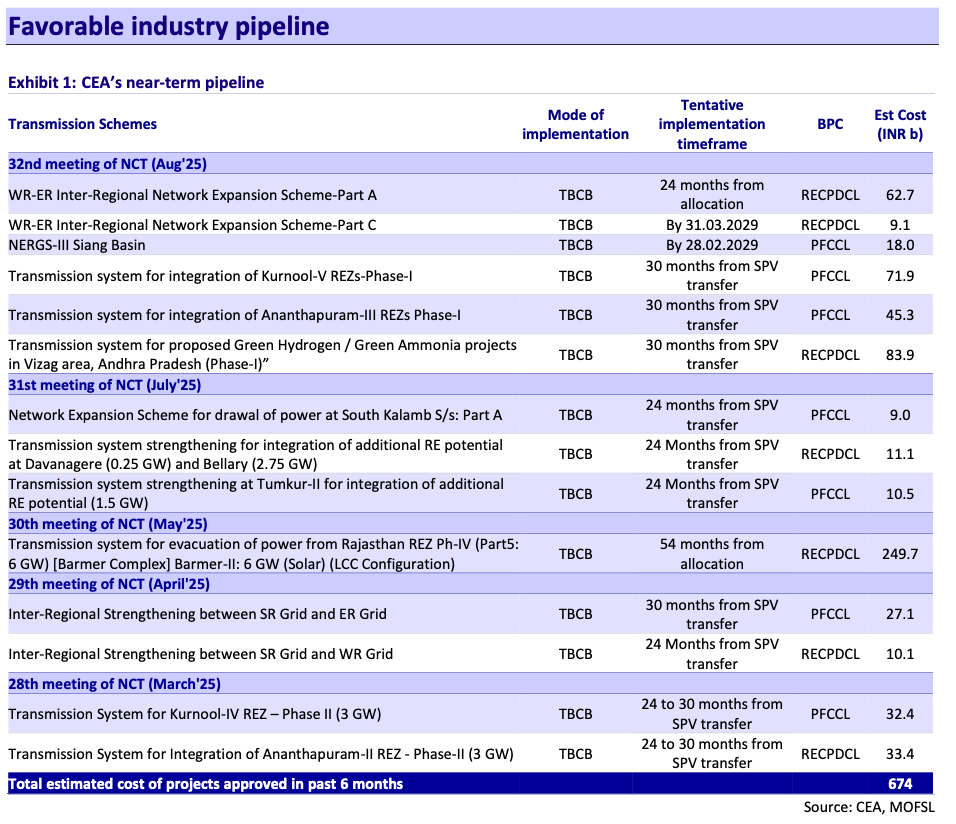
India is committing on the order of 9 trillion to build out its transmission grid over FY23-32, at the same moment the world is short of transformers, with US lead times stretching to two-to-four years and imports meeting 80% of US power-transformer supply.
Every large transformer in that build-out needs a specialty conductor CTC in its windings. Yet CTC and specialty winding wire are made at scale by only 3-4 qualified Indian players, whose combined specialty capacity is expanding from roughly 45 kt to 77 kt by FY28 with plants already running near-full, protected by five-to-seven-year end-utility qualification cycles, and pinched further by parallel shortages of insulators, grain-oriented electrical steel and bushings. The transformer boom is the headline everyone knows; the CTC bottleneck one layer beneath it is the story this document tells.
Disclaimer - Nothing is a buy or sell recommendation. All the content present here is only for educational purposes
Key pointers to take away:
1. CTC is a specialty, not a commodity. Copper is 85-90% of its cost but is a pure pass-through; the entire economic value is in the fabrication and decisively in the qualification to supply grid utilities. This is why unit economics diverge so sharply between players with different product mixes.
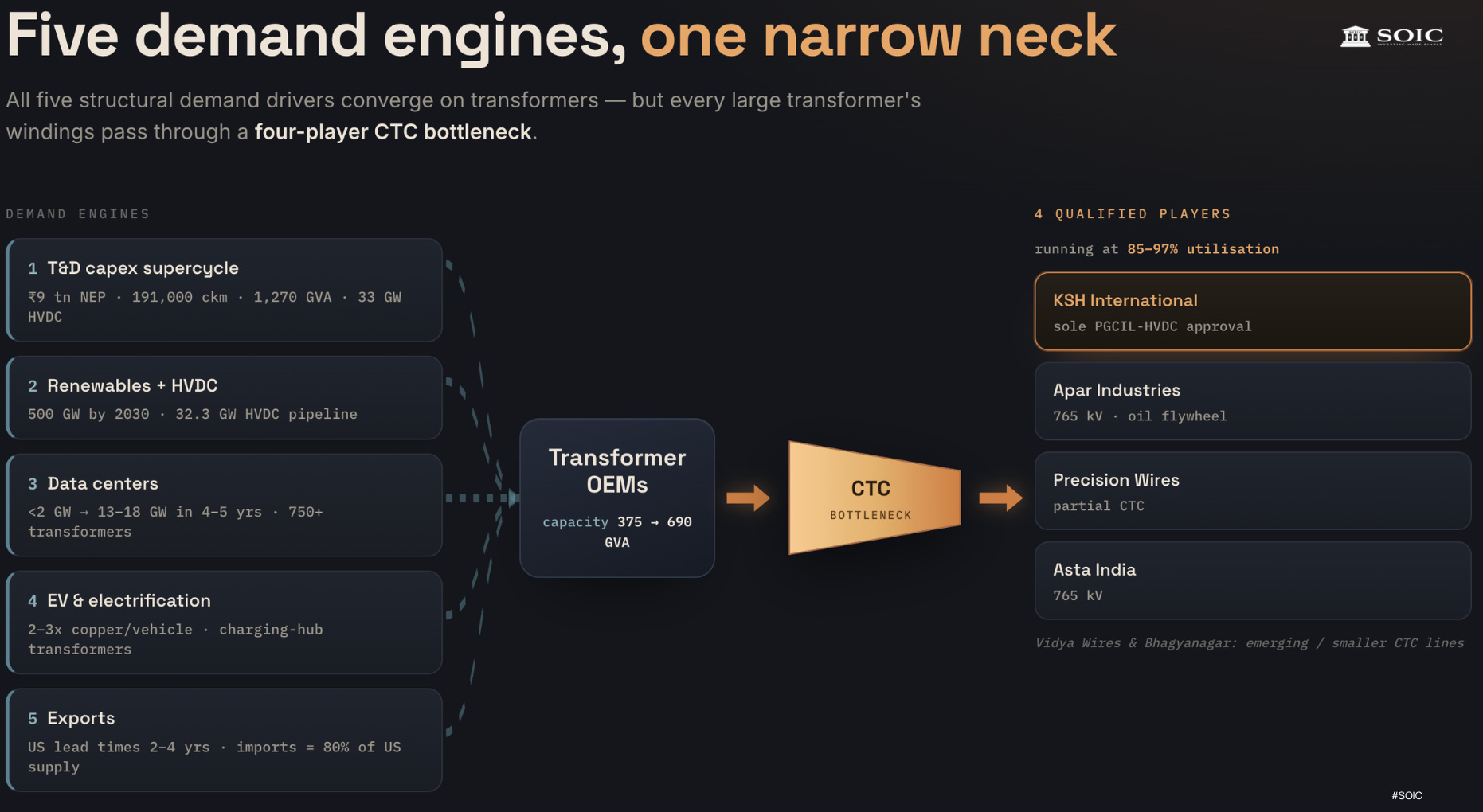
2. The demand is genuinely structural and five-headed, the T&D capex supercycle, renewables evacuation, data centers, EV/electrification, and an export pull from a global transformer shortage. Each converges on more transformers, and therefore more CTC.
3. The supply base is astonishingly narrow. Four players :- KSH International, Precision Wires, Apar and Asta India make specialty (CTC/PICC) winding wire at scale. Their plants run at 85-97% utilisation.
4. Approvals are the moat. KSH is the only Indian company with PGCIL approval to supply CTC for HVDC transformers. A new entrant needs 5-7 years to work up the voltage classes and win end-utility qualification.
5. The bottleneck is corroborated from the demand side. Quality Power, an HVDC-equipment maker, told investors it was not accepting new orders because of shortages it named as “CTC cable, insulators, copper, transformer oil,” and is building its own captive HVDC-CTC line because only KSH makes it in India.
6. India’s upstream copper deficit frames everything. India imports over 90% of its refined copper and became a net copper importer in 2018-19 which is precisely why the “green copper” backward-integration theme (recycling and captive rod/cathode) recurs across almost every player.
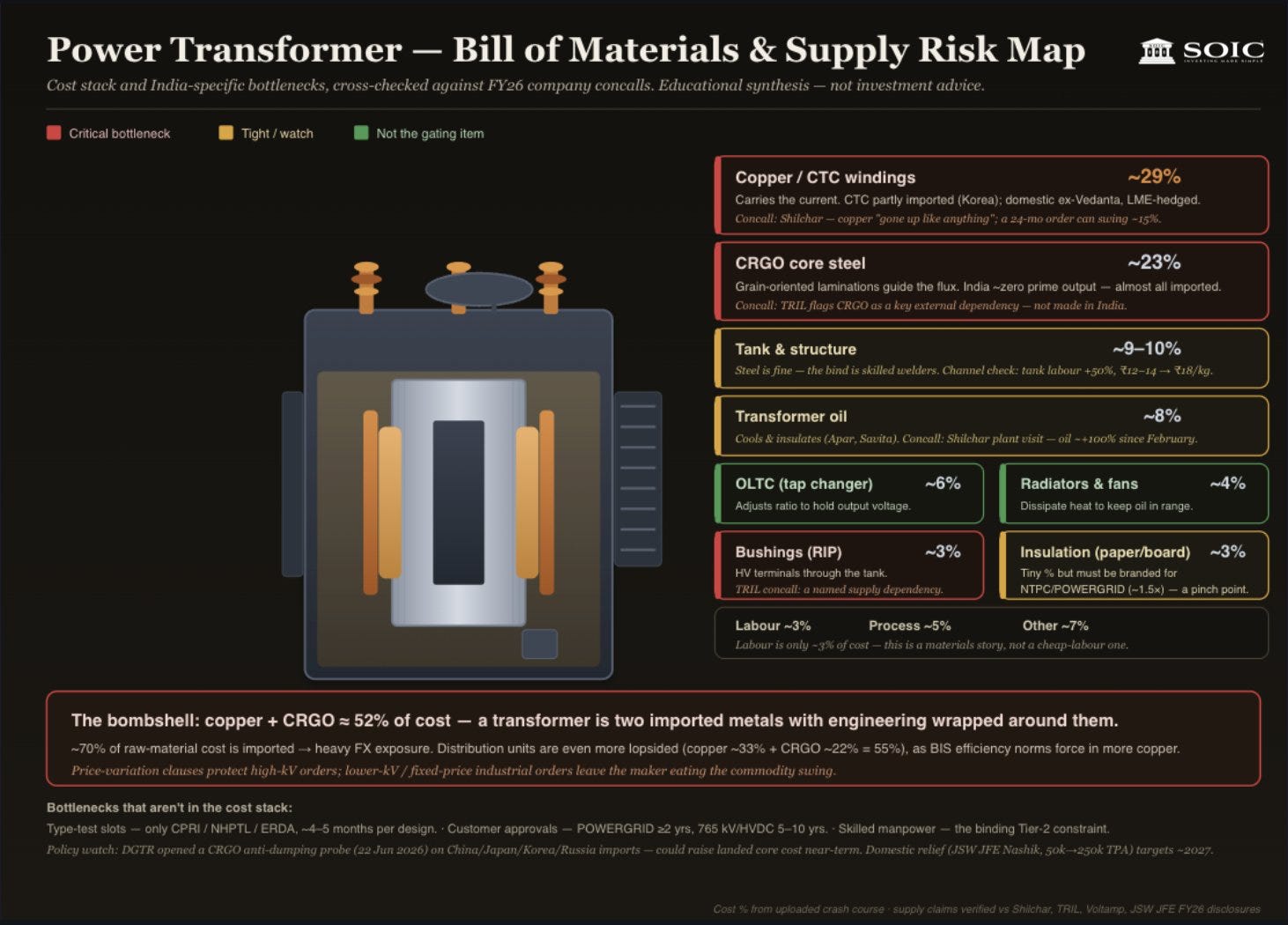
7. The parallel bottlenecks matter as much as CTC. Insulator prices rose ~4x (₹5,000 → ₹20,000) with supply at 80% of requirement; CRGO electrical steel faces a ~30% shortage with ~90% imported; bushing shortages are delaying transformer deliveries and therefore CTC offtake .
8. The five players are differently positioned. Apar is the scale leader with a transformer-oil flywheel; KSH is the CTC pioneer and sole HVDC gatekeeper; Precision Wires is the winding-wire volume leader but only a partial CTC player; Vidya Wires is a fast-scaling CTC entrant; Bhagyanagar is the recycled-copper backward-integration story that as a part of moving more and more towards VAP is also into CTC manufacturing
9. Working-capital intensity is the shared Achilles’ heel. The pass-through model plus advance payment for copper and credit to OEMs produces negative operating cash flow even amid rising profits seen at both KSH (negative CFO in FY24 and FY25) and Bhagyanagar.
10. The questions worth watching: who clears the qualification barriers (especially HVDC), who successfully integrates backward into greener/cheaper copper, and who converts announced capacity into *utilised, value-added* tonnes rather than an idle nameplate.
The thesis in one picture:
PART I - THE PRODUCT AND THE CHAIN
What CTC actually is a proper technical primer
To understand why a small, obscure conductor can bottleneck a trillion-rupee grid programme, you have to understand what it does and why it is hard to make.
The physics problem CTC solves
A power transformer works by passing large alternating currents through copper windings. In a big transformer, those currents are so heavy that a single solid conductor would be impractically thick and a thick conductor carrying AC suffers two loss mechanisms. The skin effect pushes current toward the conductor’s surface, so the interior carries less current and the effective resistance rises. The proximity effect of the magnetic fields of adjacent conductors distorts the current distribution further, creating eddy-current losses and localised hot-spots that waste energy and degrade insulation life.
The engineering fix is to split the conductor into many thin, individually-insulated strands. But simply bundling parallel strands is not enough: strands in different positions link different amounts of magnetic flux, so they would carry unequal currents and circulate energy between themselves. The elegant solution is transposition, physically rotating the strands so that each one “successively and repeatedly takes on every possible position inside the conductor cross-section” over the length of the conductor. When every strand spends equal time in every position, the flux linkage equalises, circulating currents vanish, and eddy losses collapse.
That is a Continuously Transposed Conductor: a group of enamelled rectangular copper strips, bonded together with an epoxy/bonding layer and continuously transposed, then wrapped in insulation. The result “minimises eddy current losses, reduces hotspots, and enhances transformer efficiency,” which is why CTC is “the most used technology for windings on power transformers” of large rating.
The specifications that define the product
CTC is defined by strand count and dimensions. The number of elementary strands is usually odd, ranging from 5 to 49, and up to 72 strands in some manufacturers’ ranges. KSH International’s CTC, for instance, runs 5-47 strands, 3-12.5 mm wide, 1.1-3.2 mm thick, with up to 24 layers of paper insulation, a specification range the company claims no other Indian manufacturer matches. Precision Wires’ PRECITRANS brand spans 5-72 strands. Bhagyanagar runs two 29-strand CTC lines plus a newer, larger machine.
The product family: CTC, PICC, and enamelled wire
CTC sits at the top of a family of magnet-winding-wire products that share the same customer the transformer or motor OEM but serve different rating classes:
CTC for the largest ratings: large power transformers (generally >50 MVA), generator step-up (GSU) transformers, furnace transformers, HVDC transformers and reactors, and traction locomotive transformers. CTC feeds large power transformers, enamel strip feeds medium transformers, and enamel wire feeds small transformers.
PICC (Paper-Insulated Copper/Aluminium Conductor): rectangular or round paper-insulated conductors for grid and distribution transformers.
Enamelled rectangular and round winding wires: for dry-type transformers, traction and industrial motors, appliances (AC/refrigerator compressors), and increasingly EV traction motors.
The economically important distinction is specialty vs standard. KSH splits its own book into “Specialized Magnet Winding Wires” (CTC, PICC, bunched paper-insulated wires) at ~75% of FY25 revenue, and “Standard Magnet Winding Wires” (round enamelled copper/aluminium) at ~25% with the specialised products roughly 3x more profitable per ton.
How it is made and why quality is existential
The manufacturing chain runs: oxygen-free copper rod → wire drawing (down to the required strip dimensions) → annealing (softening the copper for formability and conductivity) → enamelling (applying and curing the insulation coating) → transposing (the mechanical heart of CTC — rotating and assembling the strands) → paper/mica/Nomex wrapping for the outer insulation → inline testing → dispatch.
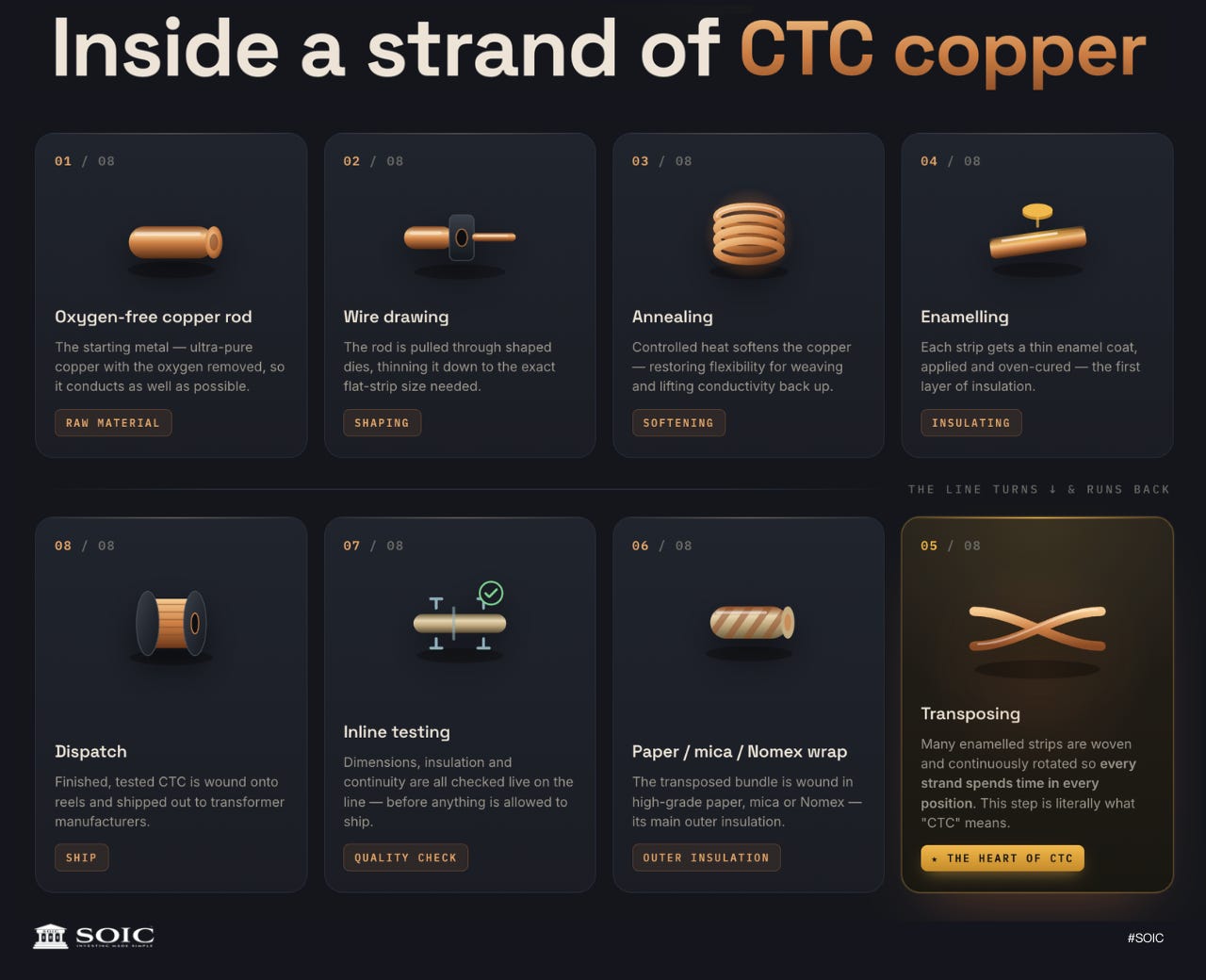
Two features make this hard to do well and hard to enter:
First, quality is existential, not incremental. As Bhagyanagar’s management describes the CTC line (while we were at their plant), “if even one strand’s enamel coating is breached anywhere along the length, the entire CTC is scrap,” and “one speck of dust spoils the coating”, cleanliness and process control are so demanding that incremental expansion is “genuinely hard”. Transformer OEMs cannot risk a winding failure in a multi-crore, multi-decade asset, so they qualify suppliers exhaustively and switch reluctantly.
Second, the process embeds tacit know-how. Bhagyanagar’s MD points to offline annealing as a deliberate differentiator: “In the automatic line annealing happens inline; here it happens offline, and offline annealing gives us much better control of the final parameter… Nobody has this old technology anymore. They try with that and they fail”. KSH’s management similarly notes that CTC lines “are all continuous processes… They run 24/7,” so a would-be backward-integrator “needs that kind of volume also” to justify a line, one reason KSH does not see OEM backward-integration as a near-term threat.
Market size and why supply is concentrated
The global CTC-for-transformer market was valued at roughly US$235 million in 2024, projected to reach US$366 million by 2031 (~6.5% CAGR). That is a small, specialised niche which is exactly why supply is concentrated in a handful of firms in China, India, Germany, Japan and the US, clustered near transformer-OEM hubs and copper-sourcing ports. In India, CTC demand and manufacturing concentrate in Gujarat, Maharashtra, Tamil Nadu and Telangana for exactly those reasons.
The value chain, stage by stage
The path from rock to transformer winding passes through seven stages. India’s competitive position varies dramatically along it → weak upstream, strengthening downstream.
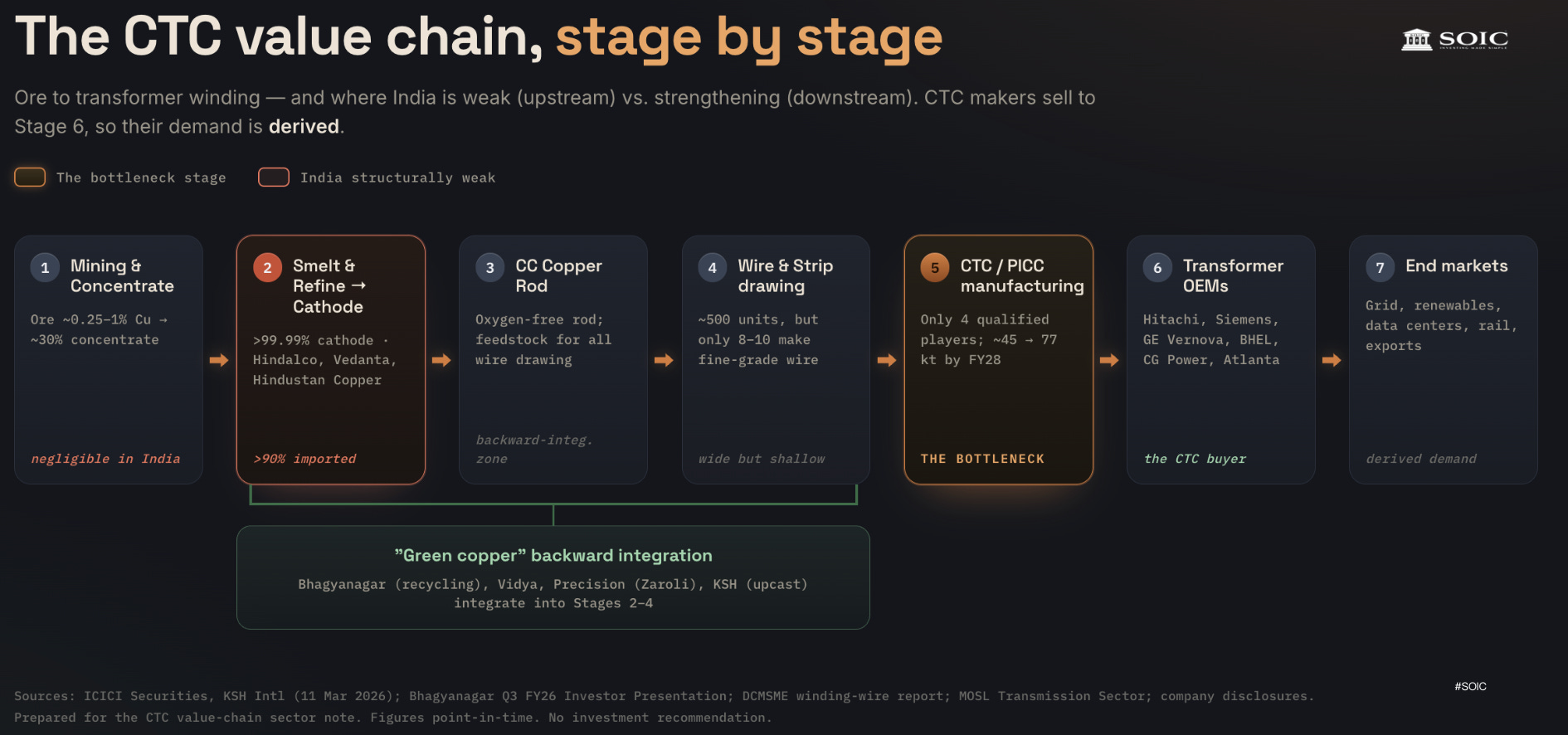
Stage 1 - Mining & concentrate. Copper ore is typically only 0.25-1% copper; it is crushed, ground and froth-floated to a ~30% concentrate. This is a globally constrained stage: the concentrate market sits in a structural deficit, aggravated by 2025 mine disruptions (the Grasberg mudslide in Indonesia, which took ~2.5% of global mine supply offline with restart not before 2027; Cobre Panamá, offline since 2023; Kamoa-Kakula flooding in the DRC). India has negligible domestic mined copper production.
Stage 2 - Smelting & refining (concentrate → 99.99% cathode). Concentrate is smelted to matte (50-70% Cu), converted to blister (98.5-99.5%), then electrorefined to cathode (>99.99%). This is India’s structural weak point and is treated in depth in Section 3.
Stage 3 - Continuous-cast copper rod. Cathode (or, for recyclers, refined scrap) is continuously cast into oxygen-free copper rod the feedstock for all wire-drawing. Several downstream players are integrating into this stage (Section 4). Hindalco, for example, acquired a continuous copper-rod facility at Asoj, Gujarat from Polycab in 2021.
Stage 4 - Wire & strip drawing. The rod is drawn into round wire or rolled into a rectangular strip. India has a large but shallow base here: roughly 500 winding-wire units with 350-400 KMT/year of installed capacity but only ~60% utilisation, and only 8-10 units making “fine size” winding wire meeting critical, transformer-grade quality. The rest is commodity-grade. This bifurcation is a wide commodity base, a razor-thin specialty tip is the single most important structural fact about the Indian supply side.
Stage 5 - CTC / specialty conductor manufacturing. The transposing, paper-wrapping and qualification step. Four players of scale (Section 10).
Stage 6 - Transformer OEMs (the buyers). Global names with India operations (Hitachi Energy India, Siemens Energy India, GE Vernova T&D India, ABB, BHEL) and large domestic listed players (CG Power, Atlanta Electricals, Transformers & Rectifiers, Voltamp, Bharat Bijlee, Shilchar, Danish Power, and many others). Adjacent equipment makers such as Quality Power (reactors, instrument transformers, HVDC air-core reactors) also consume CTC-family inputs.
Stage 7 - End markets. The T&D grid (PGCIL, state discoms), renewable evacuation (solar/wind step-up and HVDC corridors), data centers (GSU/HV substation transformers for hyperscale campuses), railways/metro (traction transformers), industrial, and exports.
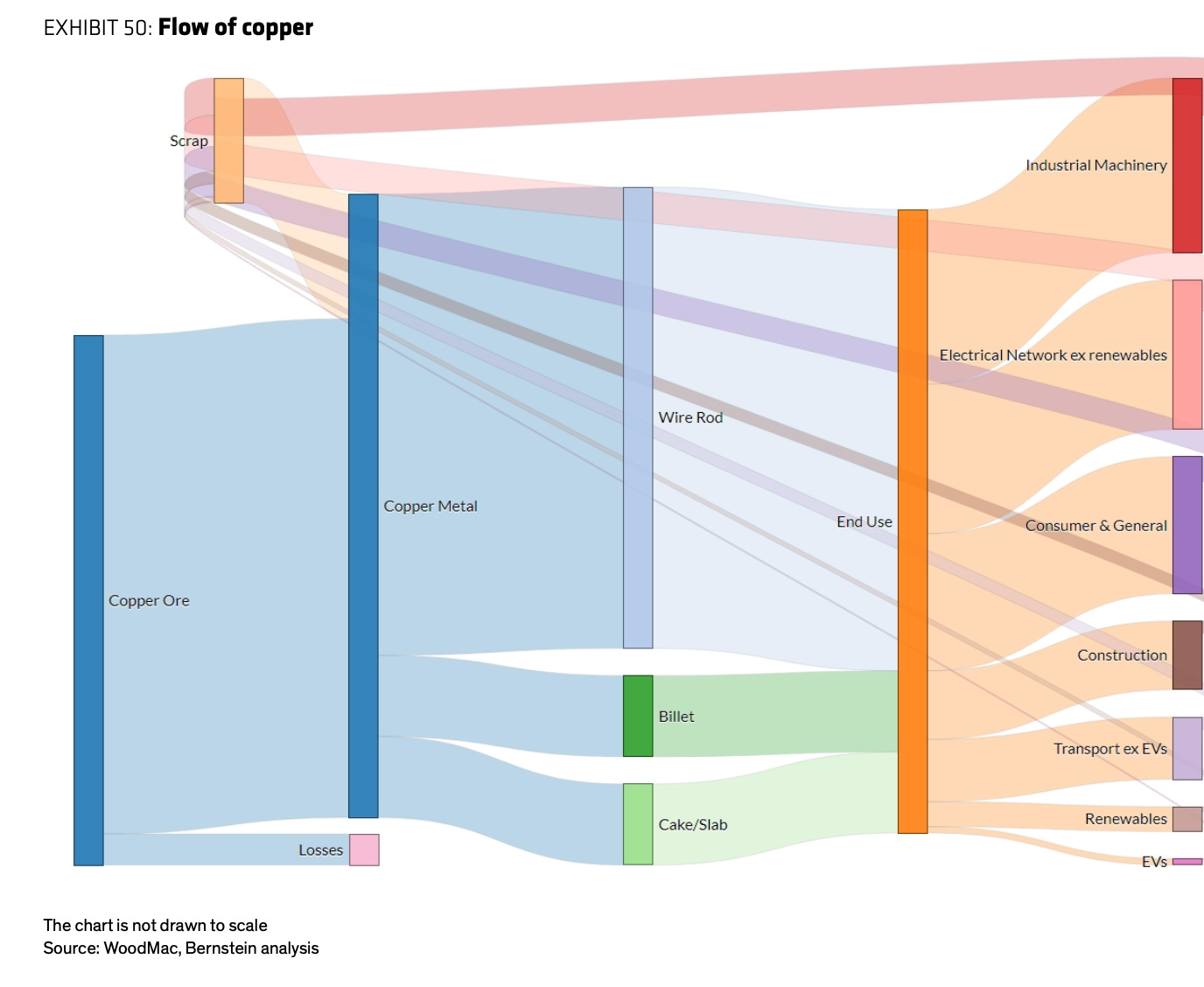
The critical structural insight: CTC makers sell to Stage 6, not Stage 7. Their demand is derived from data-center, renewable and EV growth pull CTC only through the transformer OEM. This is why the tightest read on CTC demand comes from what the transformer and grid-equipment makers say about their own order books and input shortages, which is exactly the evidence marshalled in Parts II and III.
India’s upstream copper deficit the constraint that frames everything
You cannot understand the CTC value chain without understanding that India is chronically short of the copper it feeds in at the top.
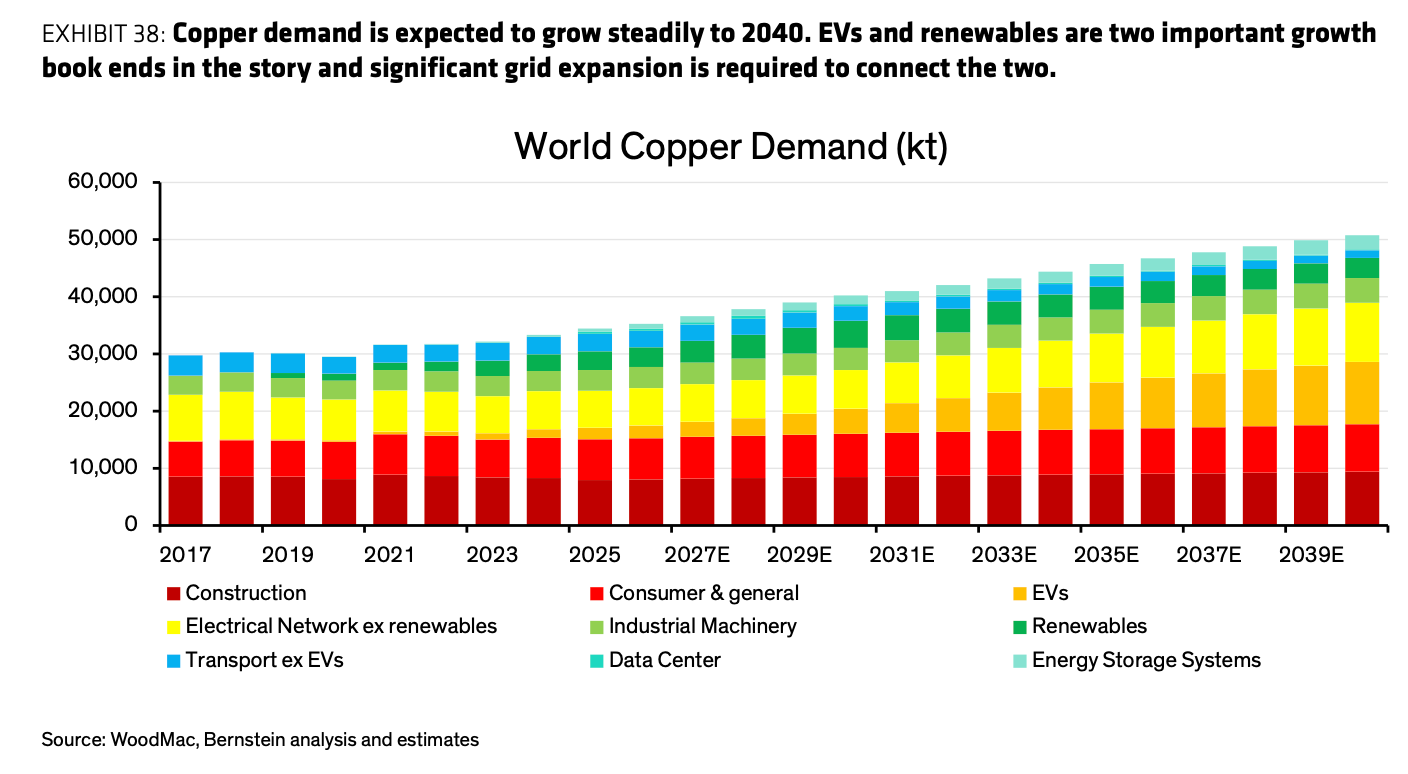
India’s copper demand reached 1,878 kilotonnes in FY25, up 9.3% year-on-year from 1,718 kt in FY24. Against that, domestic refined copper production was only ~497,000 MT in FY25 (up 7% YoY) which is significantly below domestic demand with over 90% of the requirement met through imports. India transitioned from a net exporter to a net importer of copper in 2018-19, a watershed driven by the 2018 closure of Vedanta’s Sterlite (Thoothukudi) smelter on environmental grounds, a plant that alone represented a large slice of national capacity.
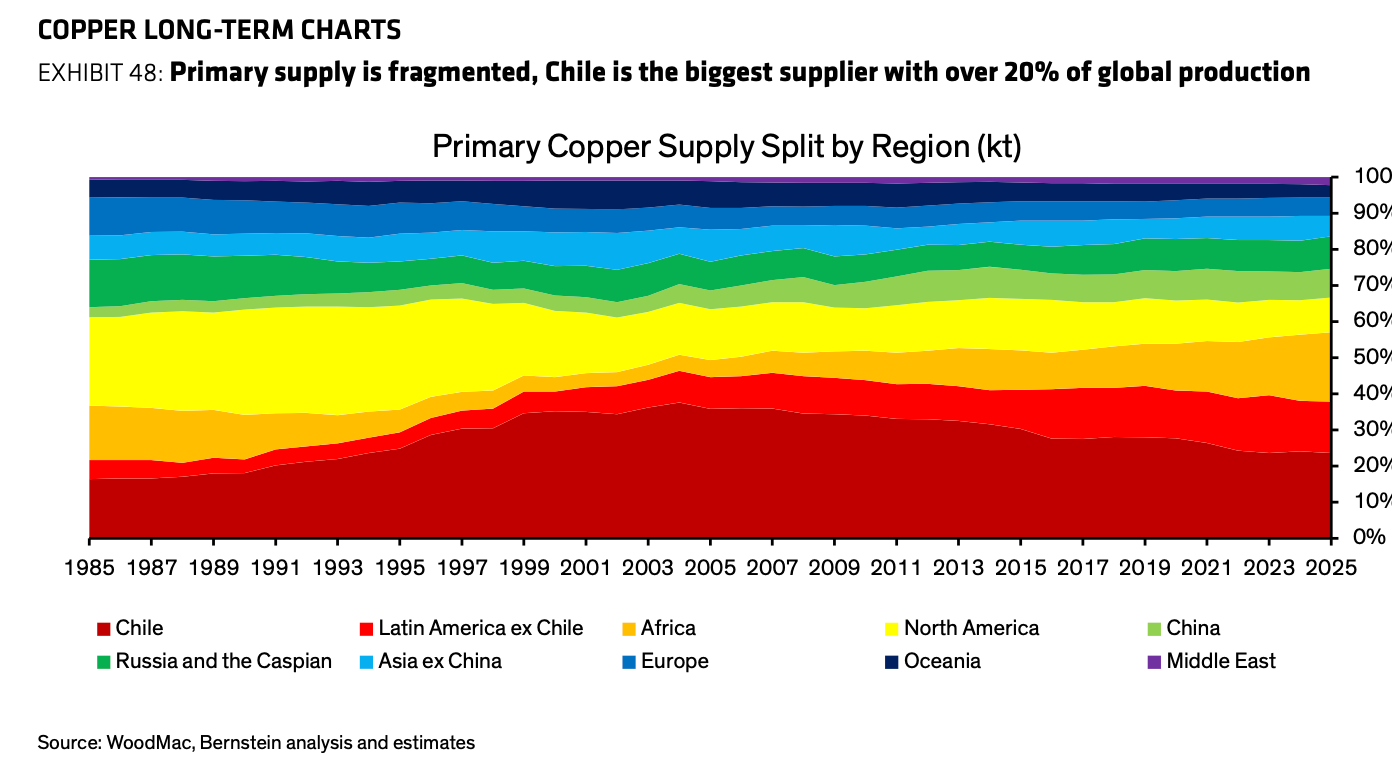
The remaining domestic refining base is thin and concentrated: Hindalco (Birla Copper) runs the Dahej, Gujarat smelter one of the world’s largest single-location copper smelters and is the world’s second-largest copper-rod producer, serving over half of India’s refined-copper demand; Vedanta/Sterlite now runs only its Silvassa plant (~148,000 t cathode); and state-owned Hindustan Copper is India’s only vertically integrated producer, from mine to continuous-cast rod.
The gap is widening, not closing. The Indian Copper Association estimates India needs ~500,000 tonnes of new refined capacity every five years just to keep pace with demand growing ~9% a year, while recent additions (Hindustan Copper, Hindalco, Adani’s Kutch Copper) add only ~100,000 tonnes against ~1.8 million tonnes of demand “modest” against the need. Hindalco targets selling 1 million tonnes of refined copper by FY30, but the structural deficit is likely to persist.
Three consequences for the CTC chain flow directly from this deficit:
1. Every downstream player is an LME price-taker with import exposure. Copper is 85-90% of a CTC maker’s cost, and most of it is imported cathode/rod or scrap, priced off the London Metal Exchange. This drives the pass-through model and the working-capital intensity discussed in Section 12.
2. It creates the strategic logic for backward integration into recycling and captive rod/cathode the “green copper” theme (Section 4), which almost every player in this report is pursuing precisely because domestic virgin cathode is scarce and imported metal is dear.
3. A supportive policy backdrop is emerging. India’s 2025 Union Budget eliminated the basic customs duty entirely on copper scrap and waste (down from 5% in 2021, to 2.5%, to nil) explicitly to boost domestic recycling capacity for the EV and electronics sectors, a direct tailwind for the recyclers.
The green copper backward-integration theme
Given the upstream deficit, one of the most striking features of the Indian CTC cohort is how many players are integrating backward into recycling scrap or making their own rod/cathode to control cost, quality, and their sustainability footprint. This is not incidental; it is a coherent strategic response to Stage 2 scarcity.
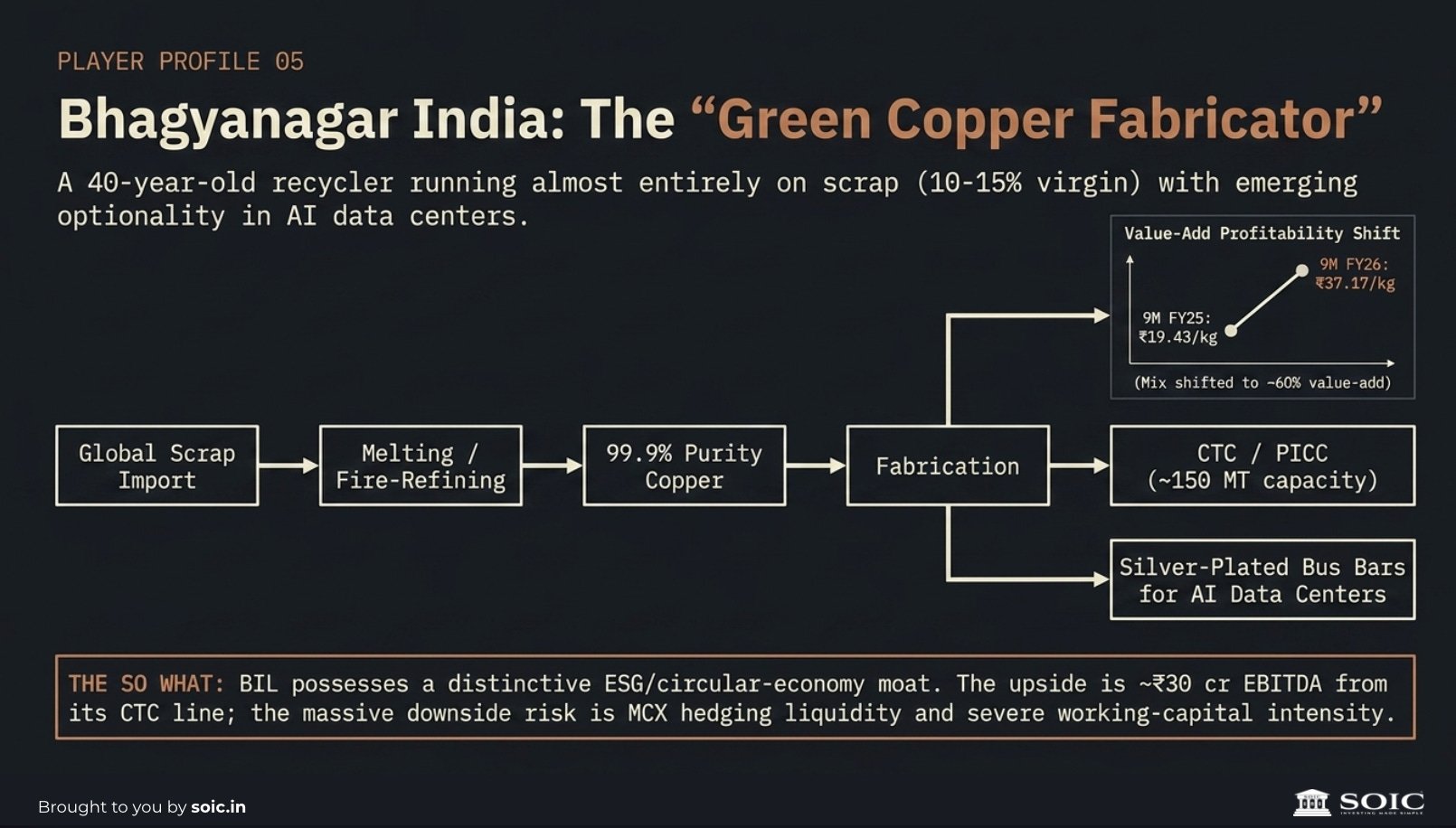
Bhagyanagar India is the fullest expression. It is a 40-year-old copper recycler that sources scrap globally, melts and fire-refines it to 99.9% purity (up to 99.95% for some products “among the highest in the Indian secondary copper space”), and casts its own rod, running the business almost entirely on recycled metal: “our predominant use is recycled copper only… we do use about 10-15% of virgin copper”. Its scrap economics are precise: high-quality scrap (clean telecom/cable copper) is sourced at ~5% discount to LME (~95% of LME), lower-quality mixed scrap at ~15% discount (~85% of LME). Its metallurgical edge is the ability to deliver near-zero-oxygen copper from dirty scrap that “most other recyclers cannot”. There is an important nuance here for readers: Bhagyanagar uses a fire-refining (scrap → rod) route, not an electrolytic green cathode route; the fully electrolytic green-cathode approach in India is being pursued by a competitor, Jain Resource Recycling, whom Bhagyanagar’s own management names as its main domestic rival. We keep the focus on Bhagyanagar’s recycling model. Also other recyclers seeing this tailwind have announced a big capex in copper recycling like Pondy Oxides and Gravita India.
Vidya Wires makes “35% to 40% of our copper rod requirements internally” as oxygen-free rod from copper cathodes, describing this vertical integration as a key pillar of our competitive advantage for cost and quality control. It sources cathode from Vedanta, Union Copper Rod and Marubeni, and draws 26% of its power from its own solar and wind installations.
Precision Wires India is building a ₹240 crore copper recycling/refining plant at Zaroli, Gujarat to produce 99.99% cathode and rod for captive use, targeting 20-35% of its raw-material needs at full utilisation (FY28) funded 60:40 debt-to-internal-accruals.
KSH International has proposed in-house upcast copper-rod manufacturing to recycle its own process scrap (FY25 scrap sales were ₹120.4 crore) instead of selling scrap at a discount and rebuying fresh rod a “green copper” initiative expected to add an estimated ₹2,000-3,000 per tonne to EBITDA, targeted for FY27-28.
The through-line: in a country structurally short of virgin cathode, the ability to source, recycle and refine your own copper is becoming a competitive weapon on cost, on quality control, and on the ESG credentials that increasingly matter to global transformer-OEM customers.
PART II - DEMAND: FIVE ENGINES, ONE DESTINATION
CTC makers do not sell to end markets directly they sell to transformer OEMs, who sell to utilities, developers and industrial buyers. So the demand case for CTC is a derived case: it holds only if the underlying pull for transformers is real, large and durable. It is all three, driven by five structural engines that all converge on the same destination: more transformers, and therefore more CTC. This part lays out each engine with the hard numbers.
Demand engine 1 - the T&D capex supercycle
The foundational engine is India’s transmission-and-distribution build-out, and its scale is hard to overstate.
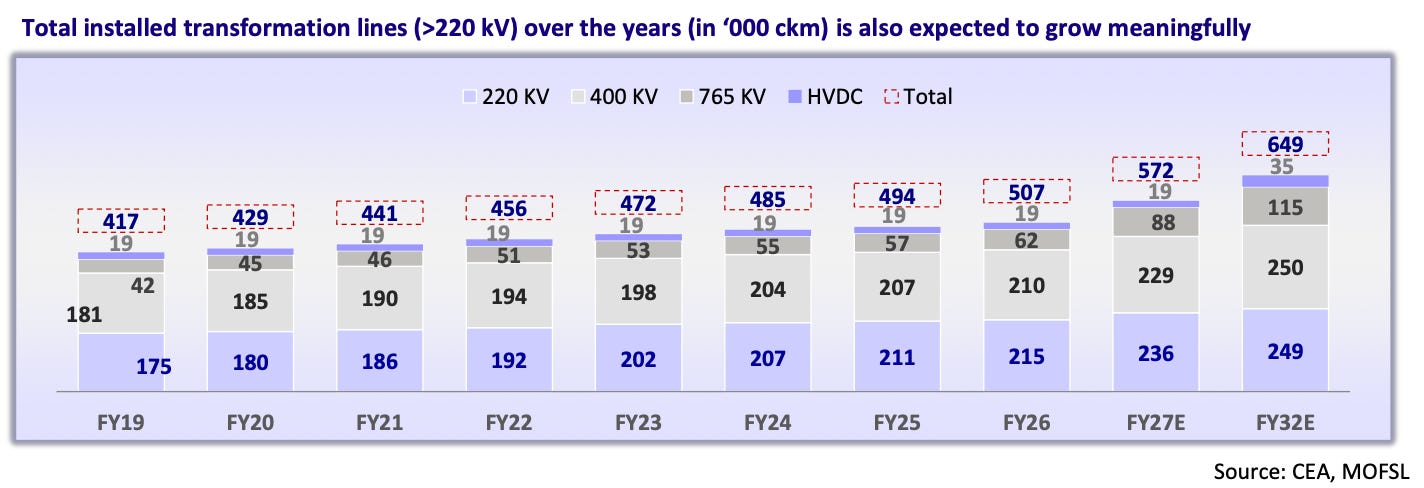
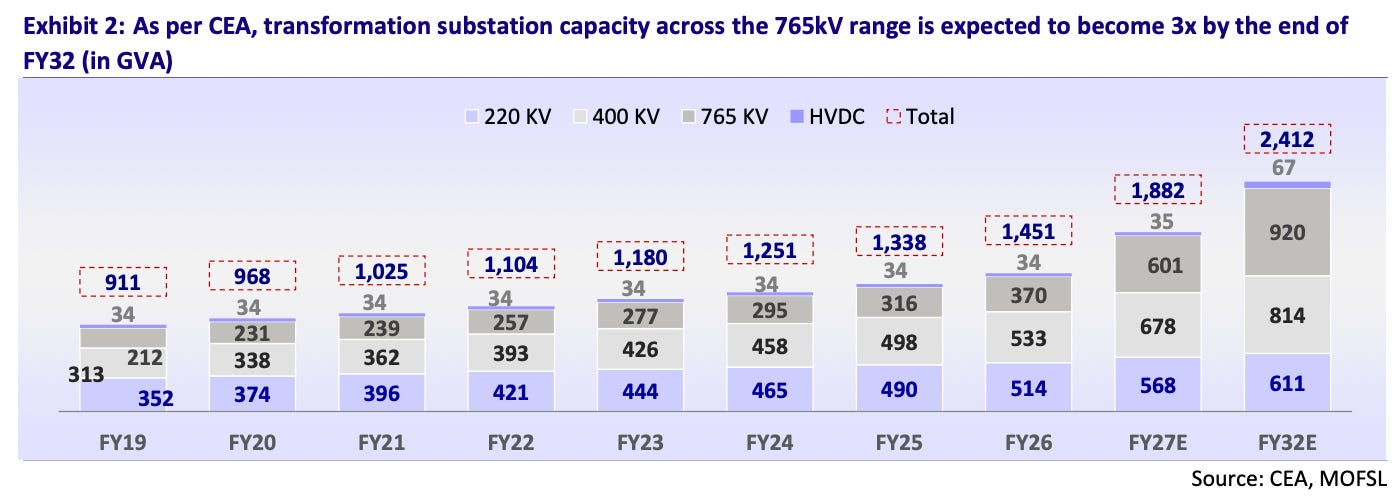
The National Electricity Plan. India’s Central Electricity Authority prepared a detailed NEP (Transmission) to move 500 GW of renewable energy by 2030 and support over 600 GW of installed capacity by 2032. To do that, the plan calls for adding, over FY2022-23 to FY2031-32 (220 kV and above):
Over 191,000 circuit-km of transmission lines (from ~456,716 ckm to ~648,190 ckm);
1,270 GVA of transformation capacity (from ~10,70,950 MVA to ~23,45,135 MVA);
33 GW of HVDC bi-pole links;
Inter-regional transmission capacity rising from 119 GW today to 143 GW by 2027 and 168 GW by 2032.
The rupee figure: ~₹9 trillion. Total planned transmission investment under the NEP for FY23-32 exceeds ₹9 trillion split roughly ₹4.25 trillion in FY22-27 and ₹4.91 trillion in FY28-32 which could translate into ordering of roughly ₹1 trillion per year. Layered on top are the National Green Hydrogen Mission (₹197.4 billion of transmission-linked investment) and the Revamped Distribution Sector Scheme (RDSS, ~₹3 trillion).
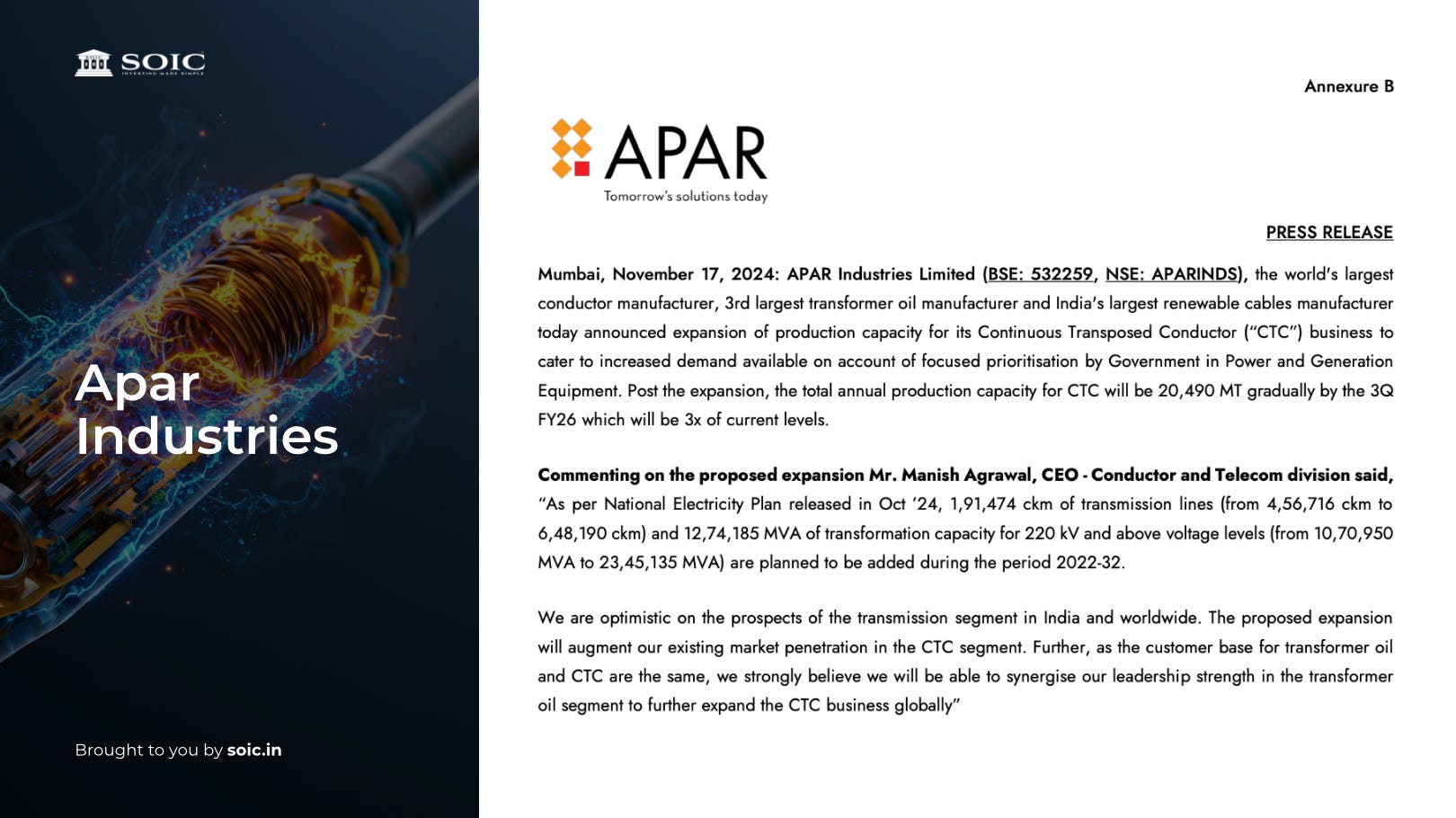
This is a genuinely relevant fact for CTC because Apar Industries explicitly cited these exact NEP numbers as the rationale for tripling its CTC capacity: “As per National Electricity Plan released in Oct ‘24, 1,91,474 ckm of transmission lines… and 12,74,185 MVA of transformation capacity for 220 kV and above… are planned to be added during the period 2022-32. Post the proposed CTC expansion… our capacity will be 3x of current levels”.
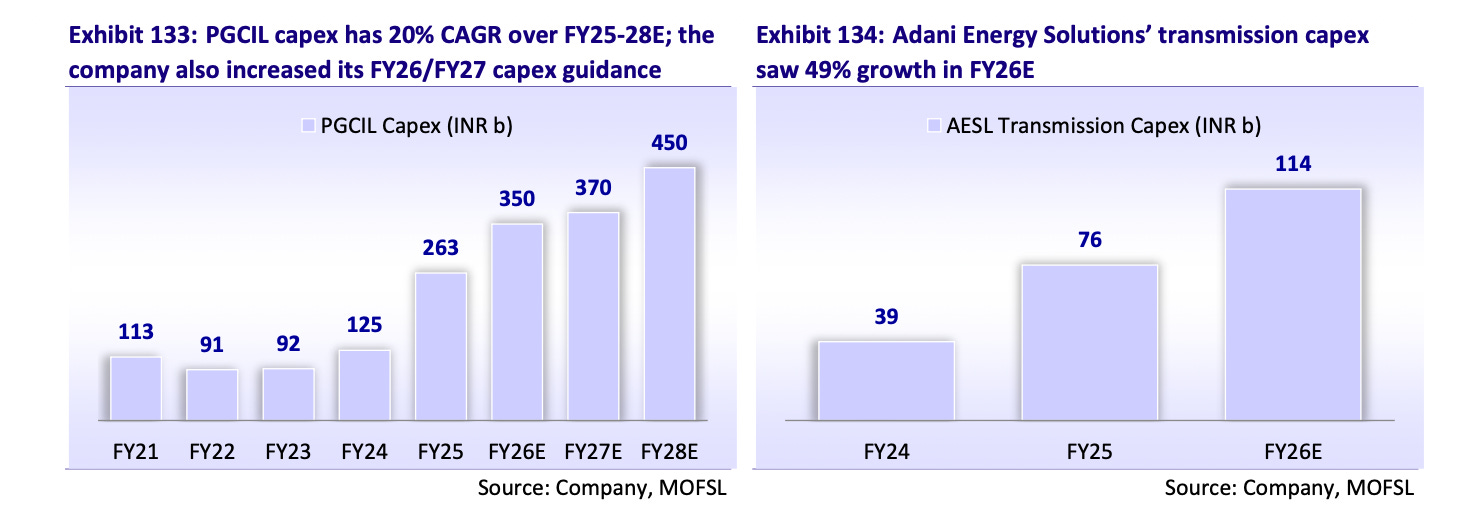
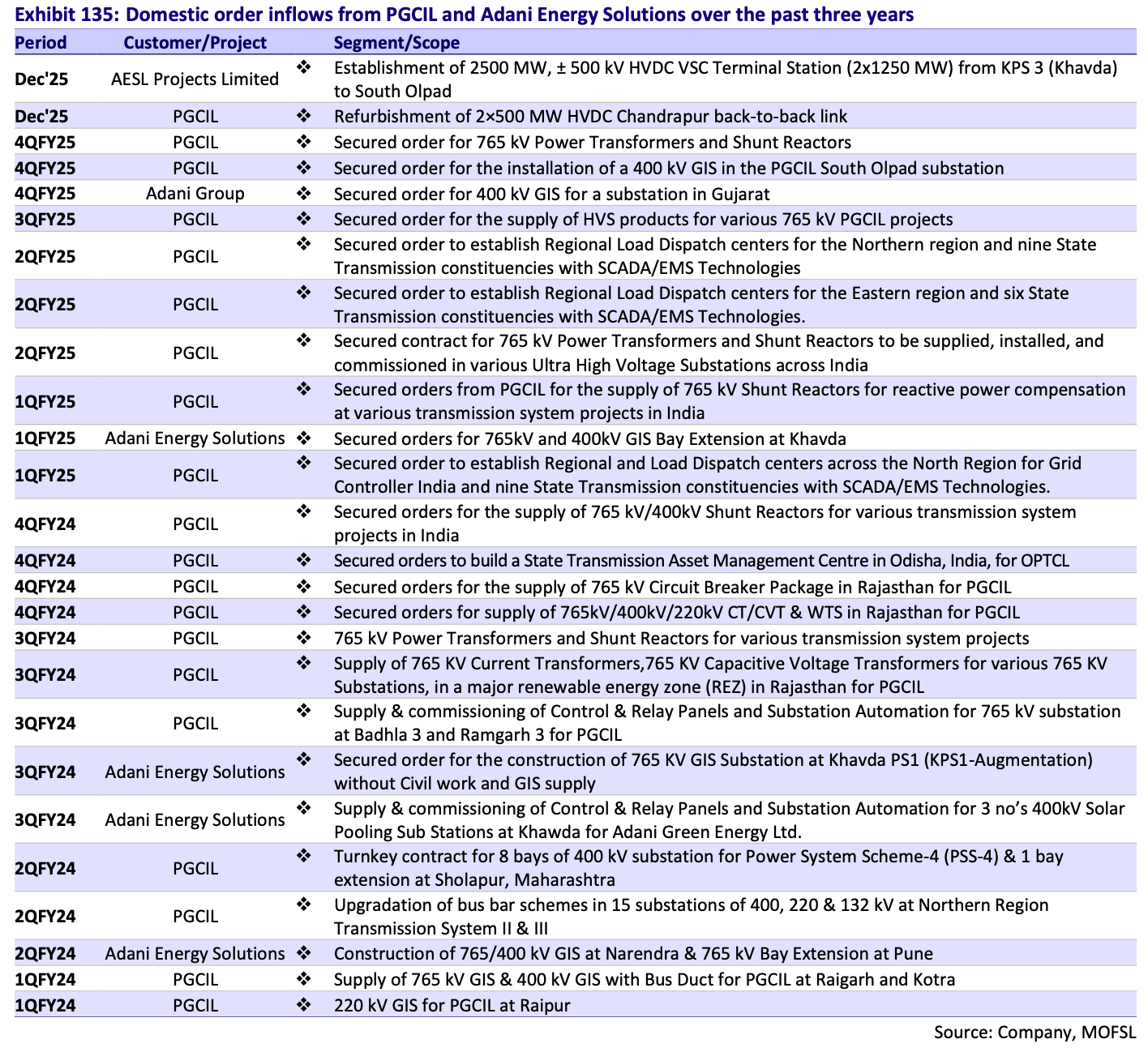
Utility capex is ramping to match. Power Grid Corporation’s capex is guided to rise from ~₹263 billion (FY25) to ~₹450 billion (FY28E), a ~20% CAGR, with ~₹3.1 trillion planned through FY32. Adani Energy Solutions’ transmission capex is expected to rise from ~₹76 billion (FY25) to ~₹114 billion (FY26E), up 49%. FY25 was one of the strongest tendering years on record, with over 45 tenders awarded to utilities carrying ~₹1.5 trillion of capital outlay.
The transformer OEMs are doubling down proof the demand is being felt. India’s total transformer-manufacturing capacity is expanding from 375 GVA (FY25) toward ~690 GVA (FY28E), with ~315 GVA of additional capacity under construction at ~₹66 billion of investment. Individual expansions are large: CG Power is doubling transformer capacity from 40,000 to 85,000 MVA to become India’s 1 player; Atlanta Electricals quadrupled from ~16,740 to ~63,060 MVA; Siemens Energy India is scaling from 15,000 toward 60,000 MVA [MOSL, pg. 140-141]; and Hitachi Energy India board-approved a ₹20 billion greenfield transformer facility adding 30-40 GVA (~2x), on top of a ₹20 billion plan from Oct 2024 — ₹40 billion cumulative. Every one of those incremental GVA needs winding wire; the highest ratings need CTC.
A note on lumpiness, the near-term caveat. FY26 tendering actually fell to just 16 schemes from 45 in FY25 but some attribute this to temporary bandwidth constraints (utilities executing backlog, manufacturers shifting to higher-voltage, longer-cycle products) rather than any structural demand slowdown. India’s T&D capex has always been lumpy, delayed by land acquisition, financing and clearances a genuine near-term risk to the timing (though not the direction) of CTC offtake.
Demand engine 2 - renewables and the HVDC pipeline
Renewables are both a demand engine in their own right and the primary rationale for the most CTC-intensive transformers of all HVDC.
The macro target. India crossed 500 GW of total installed capacity with non-fossil sources exceeding 50% by early 2026, against a 500 GW non-fossil target for 2030. FY26 saw a record ~55 GW of non-fossil capacity added in a single year. The NEP transmission build-out is explicitly justified by large-scale renewable energy integration.
Storage adds a second layer. The NEP plans ~13.5 GW of Battery Energy Storage Systems (BESS) by FY27 rising to ~51.5 GW by FY32, plus 31 GW of pumped storage; ICRA estimates India’s storage sector will need ~₹1.4 trillion of investment by CY30 [MOSL, pg. 19]. India awarded 5.4 GW of co-located solar+BESS and 2.2 GW of standalone BESS in the first half of CY25 alone. Storage substations, like all substations, need transformers.
HVDC is the CTC-intensive prize. Renewable evacuation over long distances from the solar zones of Rajasthan and Gujarat to load centres is driving a large HVDC programme. The NEP prospective pipeline is 32.3 GW of HVDC, of which ~14.5 GW is already tendered or awarded.
Named projects include Khavda-South Olepad (2.5 GW, GE Vernova, VSC), Khavda-Nagpur (6 GW, Hitachi Energy + BHEL, LCC) and Bhadla-Fatehpur (6 GW, Hitachi Energy + BHEL, LCC), with more to come (Bikaner-Begunia, Barmer-South Kalamb, India-Sri Lanka, Paradeep-Port Blair). One can expect one to two HVDC awards annually going forward, with HVDC accounting for ~40% of the electrification market. This matters intensely for CTC because HVDC transformers are among the most demanding and CTC-heavy of all and, as we will see, only one Indian CTC supplier is PGCIL-qualified for them. As one can frame it: “Every one of those HVDC lines will be requiring HVDC transformers at both ends and every one of those transformers requires CTC conductors to meet PGCIL’s exacting qualification standards”.
Demand engine 3 - data centers
Data centers are the fastest-growing new pull on high-voltage transformers, and therefore on CTC.
The capacity ramp. Hitachi Energy’s management sees India’s data-center capacity rising “from less than 2 GW to 13-18 GW over the next 4-5 years”. Hyperscalers (Microsoft, Google, Amazon, Meta) have collectively announced over $30 billion of India data-center investment since 2023, and Reliance is planning a 3 GW AI complex at Jamnagar.
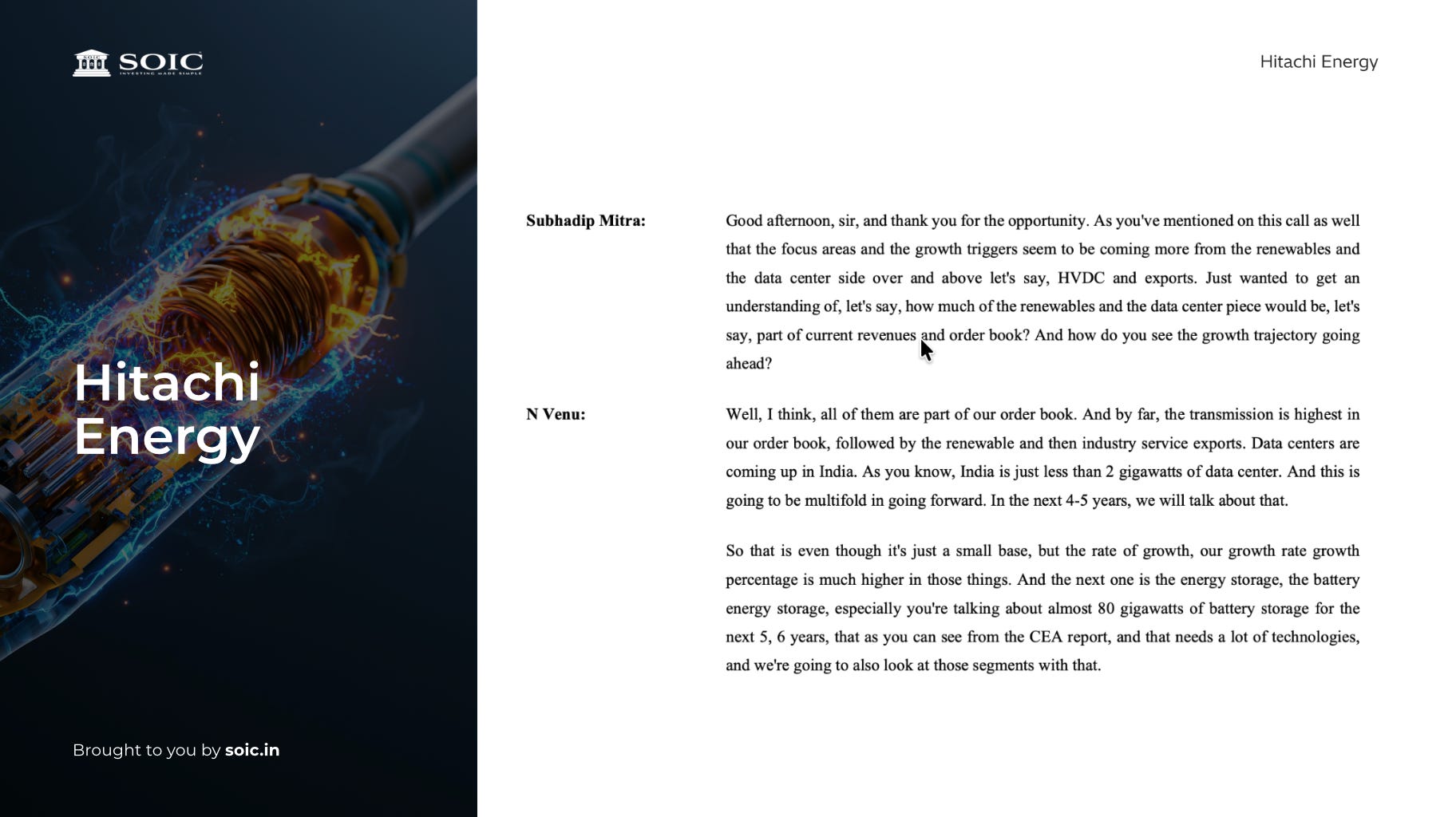
The transformer linkage is direct and already converted to orders. A hyperscale campus needs high-voltage step-up/GSU and substation transformers which need CTC in their windings. The order evidence is concrete:
CG Power won a US$99 million (~₹9 billion) order from Tallgrass in the US for a large-scale data-center project, the single largest order in its history supplying 330 kV power transformers engineered for hyperscale reliability, over a 12-20 month execution.
Hitachi Energy India is executing a 220 kV GIS substation for a Pune-area data center and notes some data centers are looking at connecting directly to HVDC through… renewable sources, a capability it can provide. Globally, Hitachi Energy expects AI data centers to grow ~3x by 2030 to a ~125 GW installed base, requiring more than 750 large transformers.
GE Vernova T&D India has worked on data-center projects for CtrlS, Capitaland, NTT and KPTCL, and references ~US$80 billion of planned US data-center/AI investment by four major US companies over 4-5 years as “a huge opportunity… in India as well”.
Quality Power started its data-center business with a Microsoft order, won a ₹49 crore order, and sizes the US data-center reactor-integration market at ~₹15 billion per annum.
The mechanism to keep clear: CTC makers do not sell to data-center operators; they sell to the transformer OEM who serves the data-center developer or utility. Data-center growth is a derivative CTC driver but a powerful and fast-accelerating one.
Demand engine 4 - EVs and electrification
The EV link needs careful framing, because it is partly direct and partly indirect.
The indirect (but large) link charging infrastructure needs transformers. CTC is a transformer-winding conductor; EV charging cables use different, non-CTC flexible conductors. So the CTC link to EV charging runs through the distribution/step-down transformers that power charging hubs, not through the charging cords.
That link is real: most commercial DC fast-charging installations require a dedicated transformer or a sanctioned-load upgrade, and India needs an estimated 1.32 million public charging stations to support 30% EV penetration by 2030 more than 40x the current base. In the US, Wood Mackenzie explicitly names EV charging as a co-driver of the distribution-transformer shortage alongside data centers, and Atlanta Electricals lists EV charging among the “new demand segments… creating incremental demand for power transformers”.
The direct link EV motor winding wire. Separately, the same manufacturers are winning EV motor-winding business, a related but distinct product from CTC. An EV uses 2-3x more copper winding wire content per vehicle than an ICE vehicle, and the value-add on EV/hybrid winding wire is much higher than on standard enamelled round wire. KSH has taken an exclusive license from HPW Metallwerk (one of only two global patent-holders) for PEEK-insulated winding wire for 800V EV traction motors, currently supplying 2-wheelers with 4-wheeler entry guided 12-18 months out. Vidya Wires is adding specialised enamelled copper strips for EVs. Precision Wires has secured approvals from “several leading EV and Hybrid vehicle manufacturers”. Bhagyanagar supplies auto-electrical components (solenoid/starter-motor electricals, magnets) to OEMs including Hyundai and Ashok Leyland.
The honest synthesis: EV electrification is a genuine, growing but still-early driver meaningful for winding-wire makers’ motor-wire lines, and a slower-burn indirect pull for CTC via charging-hub transformers. It should not be overstated as a near-term CTC driver, but it is a real long-cycle tailwind.
Demand engine 5 - exports and the global transformer shortage
The fifth engine is external: a genuine global shortage of transformers and grid equipment that is pulling Indian output into export markets.
The shortage is severe and durable. US power-transformer lead times have consistently exceeded 100 weeks (~2 years) since 2023, stretching toward 4 years for high-capacity units by 2026. Wood Mackenzie estimated the US faces a ~30% shortfall in power transformers and ~10% in distribution units in 2025, with more than half the US distribution fleet already beyond service life. Average lead times are cited around 128 weeks for power transformers and 144 weeks for GSUs. Crucially, imports account for 80% of US power-transformer supply and 50% of distribution-transformer supply. Europe has similar LPT backlogs extending 3-4 years and even the global cable majors’ backlogs have surged.
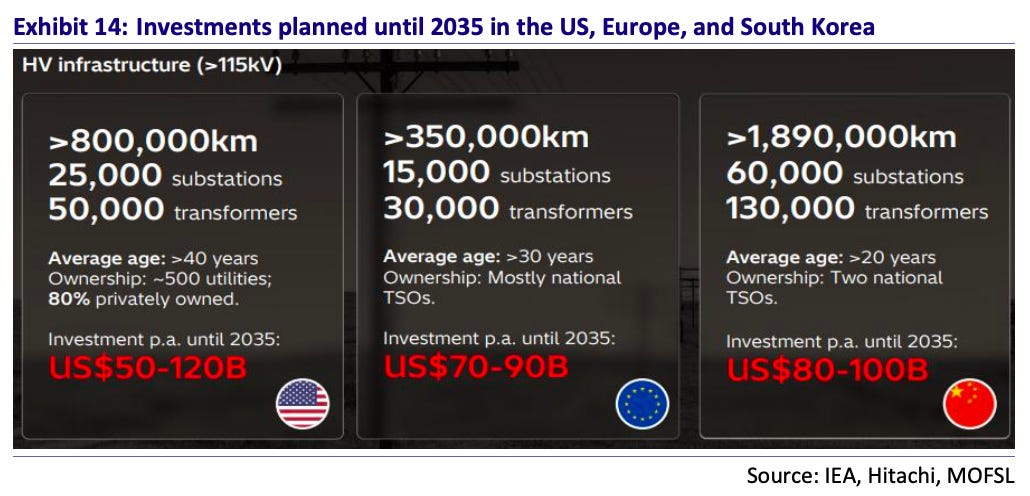
India is positioned as a feeder base. “Domestic power equipment manufacturers are benefiting from India’s growing role as a manufacturing base within global OEM feeder factory networks. Recent trade agreements between India and Europe further support export-led growth”. The evidence in the numbers:
Hitachi Energy India derives ~30% of its 3QFY26 order mix from exports (above its 25% target), executing projects across Bhutan, Australia, Southeast Asia and Southern Africa, and is building a ₹4,000-crore Vadodara facility explicitly as a 765 kV and HVDC export hub.
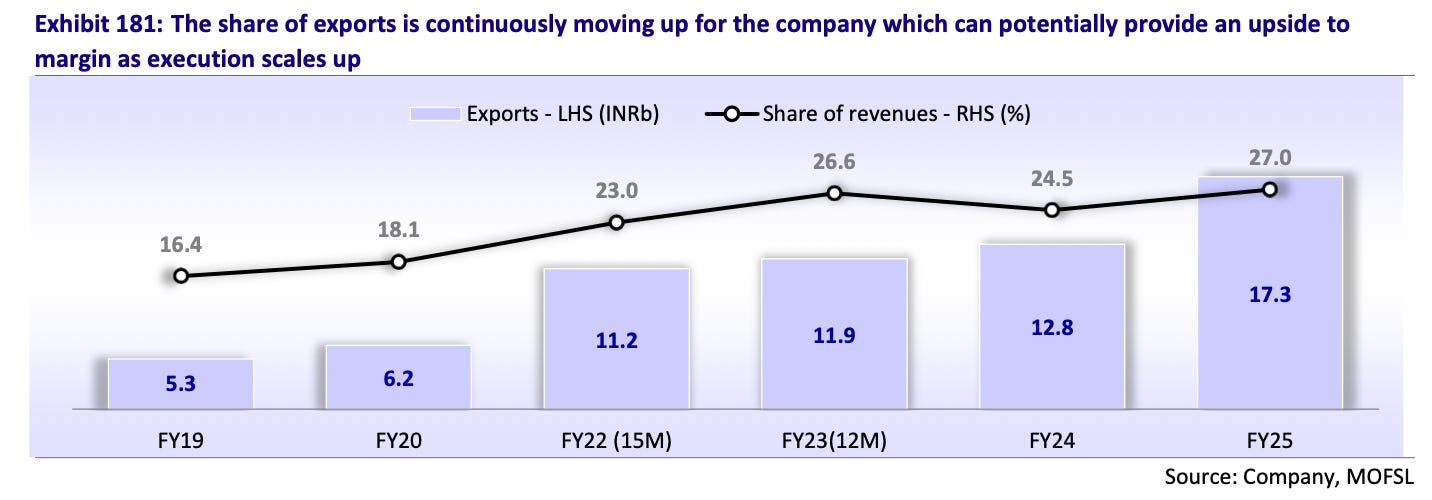
GE Vernova T&D India derives ~28-33% of revenue from exports, routed largely through GE Vernova group entities
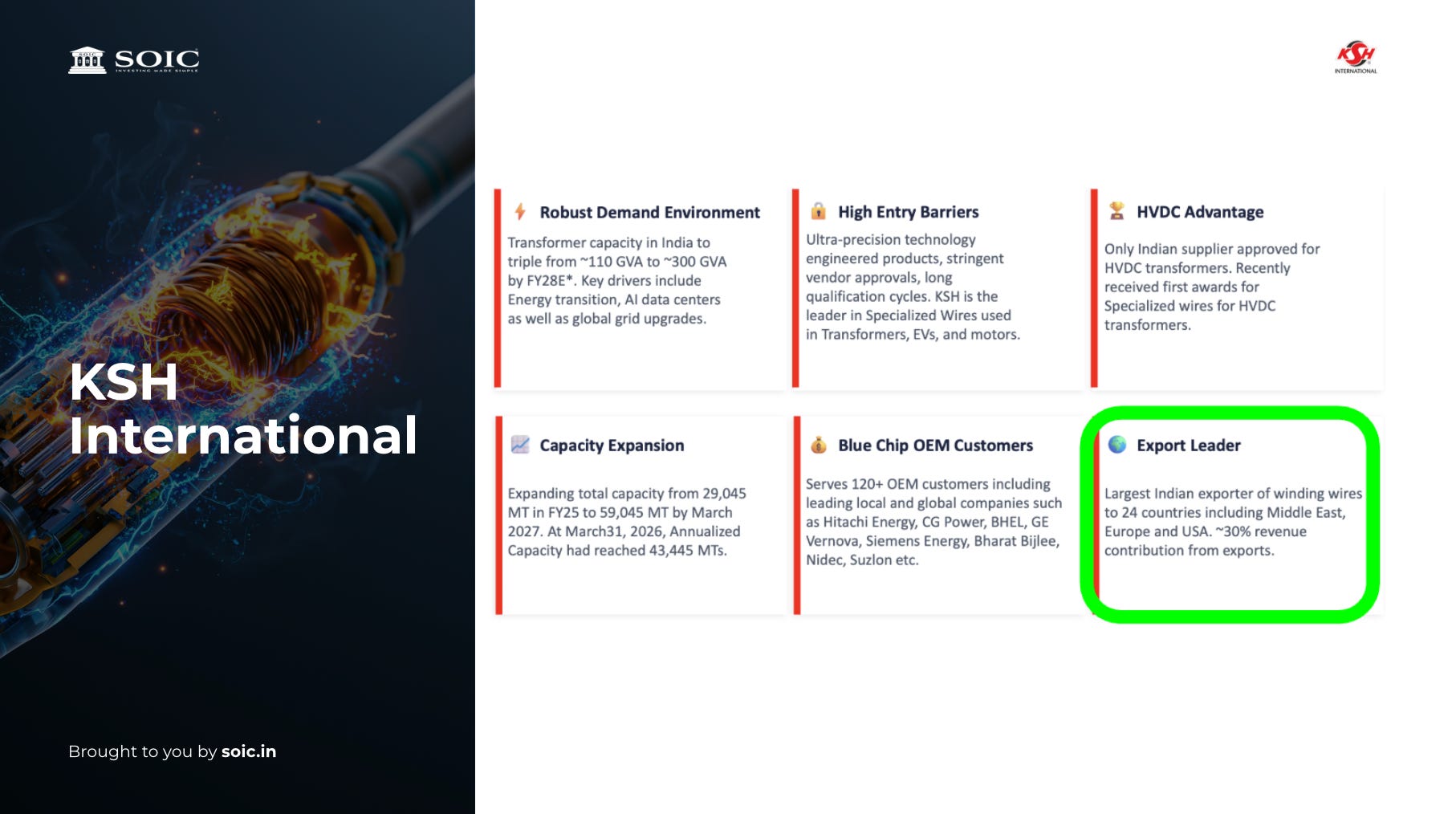
KSH International is the largest exporter of magnet winding wires from India, exporting to 24 countries, exclusively to transformer companies.
The tension worth flagging export pull is also worsening India’s own shortage. Indian OEMs diverting capacity to higher-margin exports has been cited as a contributor to India’s domestic transformer shortage, with 220 kV transformer lead times stretching from 8-9 months to ~14 months and, by 2026, to ~20 months, with transformer prices more than doubling. For CTC makers, this cuts one way: whether the transformer is destined for a US data center or an Indian solar zone, it needs the conductor. Export or domestic, the derived demand for CTC only intensifies.
One caveat on tariffs. A 50% US Section 232 tariff on semi-finished copper products (effective Aug 2025) affects copper-based exports; but only ~17% of India’s ~$1 billion semi-finished copper exports go to the US, and refined copper/anodes/scrap are excluded. For winding wire specifically, the tariff on the value-add portion has been in flux (KSH cited a move from ~54% toward a possible 18-25%, versus China’s ~34%) a live variable, but one where India remains cost-competitive.
PART III - SUPPLY AND THE BOTTLENECKS
This is the analytical heart of the document. Against the five demand engines of Part II, the supply side is astonishingly narrow, and the constraints compound. This part makes the case that the CTC value chain is genuinely supply-constrained not just tight, but structurally gated across three dimensions: the specialty conductor base itself, the parallel input shortages that choke the same transformers, and the copper-price/working-capital dynamics that constrain how fast any of these players can grow.
The specialty supply base - four players and a moat made of paperwork
The narrowness is the whole story. Against a grid build-out measured in trillions of rupees, There are only four players of scale making specialty (CTC/PICC) winding wire in India:- KSH International, Precision Wires, Apar and Asta India with Vidya Wires just has gone live with new CTC capacities and Bhagyanagar scaling its CTC business through the backward integration in green copper with combined specialty capacity expanding from roughly 45 kt today to about 77 kt by FY28. Other players exist much smaller. That is the entire qualified domestic base for the conductor that goes inside every large transformer in the country.
The CTC-specific capacity picture is tighter still
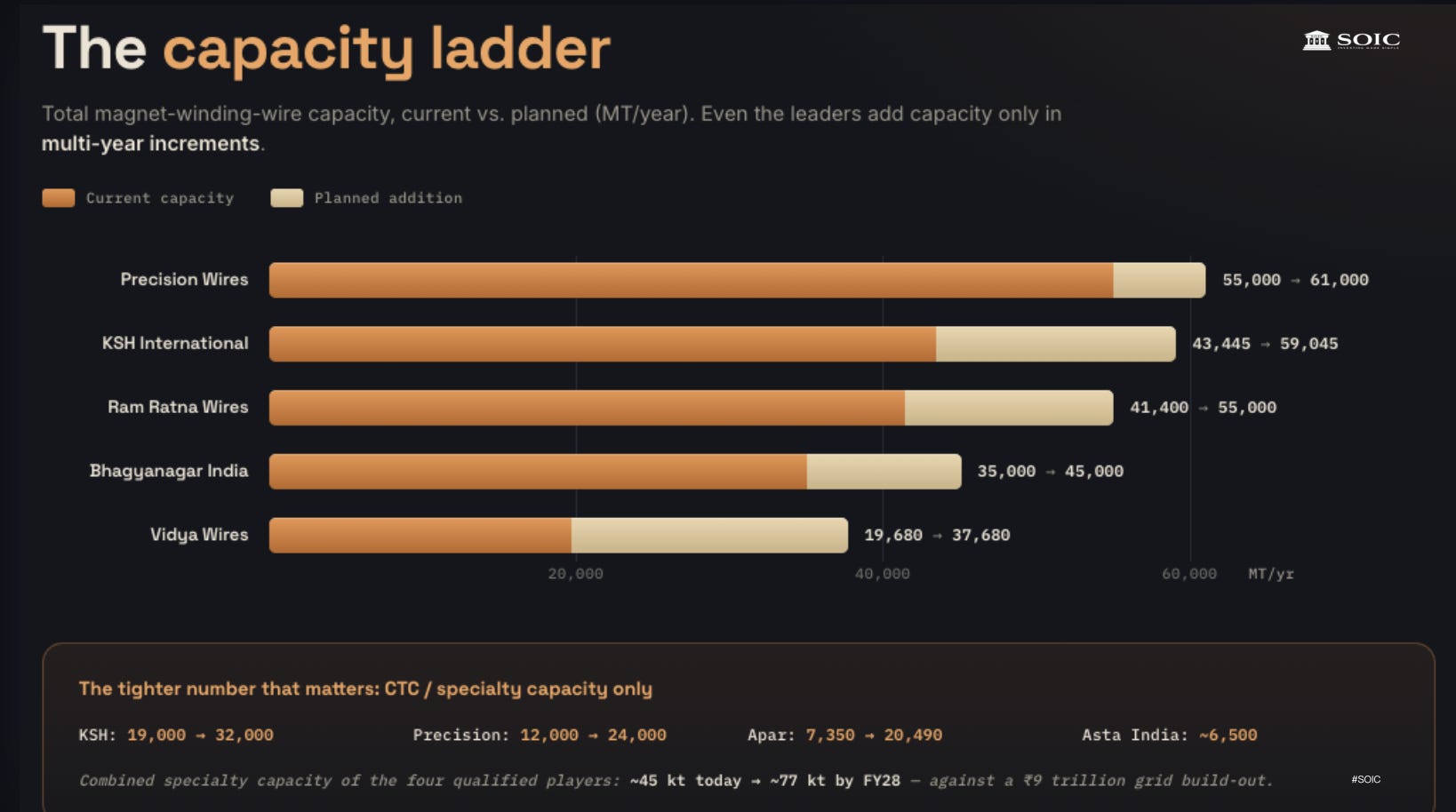
And these plants run hot. KSH’s existing facilities were operating at around 95%, 96% utilisation before its new Supa plant came on a level management called very high and it is not sustainable. Precision Wires ran at 89% capacity utilisation in FY25 (up from 86%). When the qualified supply base runs near-full and adds capacity only in multi-year increments, even strong demand cannot be met quickly, the textbook definition of a bottleneck.
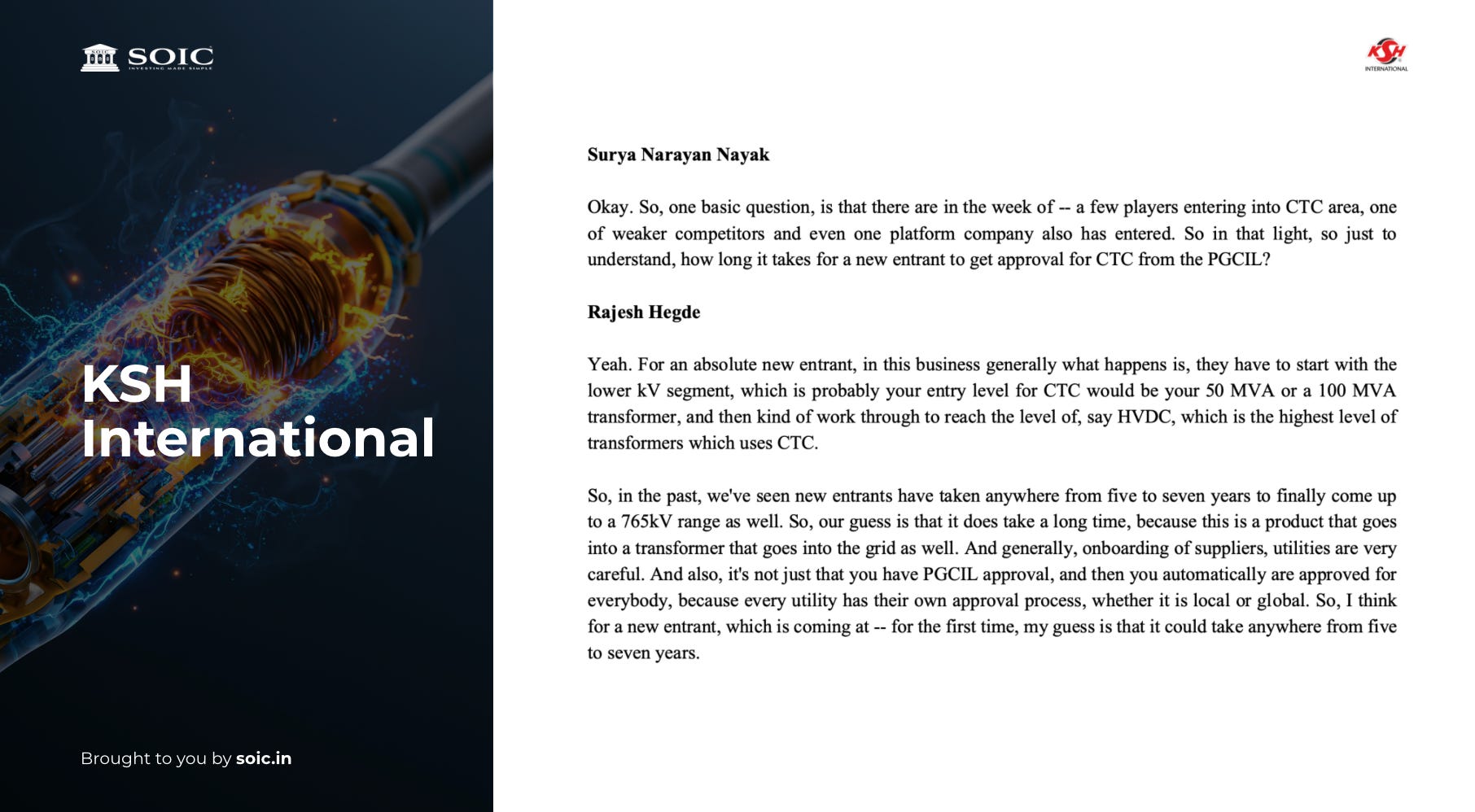
Why can’t new players just enter? The moat is paperwork, and it takes years. Making a CTC line is a capex decision; becoming a qualified CTC supplier is a five-to-seven-year odyssey. KSH’s management lays out the barrier precisely: a new entrant must not only invest, “they also need to work up that value chain of starting from a medium power transformer and then… supply it up to the 765 kilowatt [kV] transformer, which could take anything in the upwards of, say, about five to seven years for them to reach that. And finally… the biggest bottleneck for all these people would be… to get the end utility approval, which is like PowerGrid, NTPC. They all want to see a track record for your product to have been used in the field”.
The approvals matrix is the single most important exhibit in this entire report.
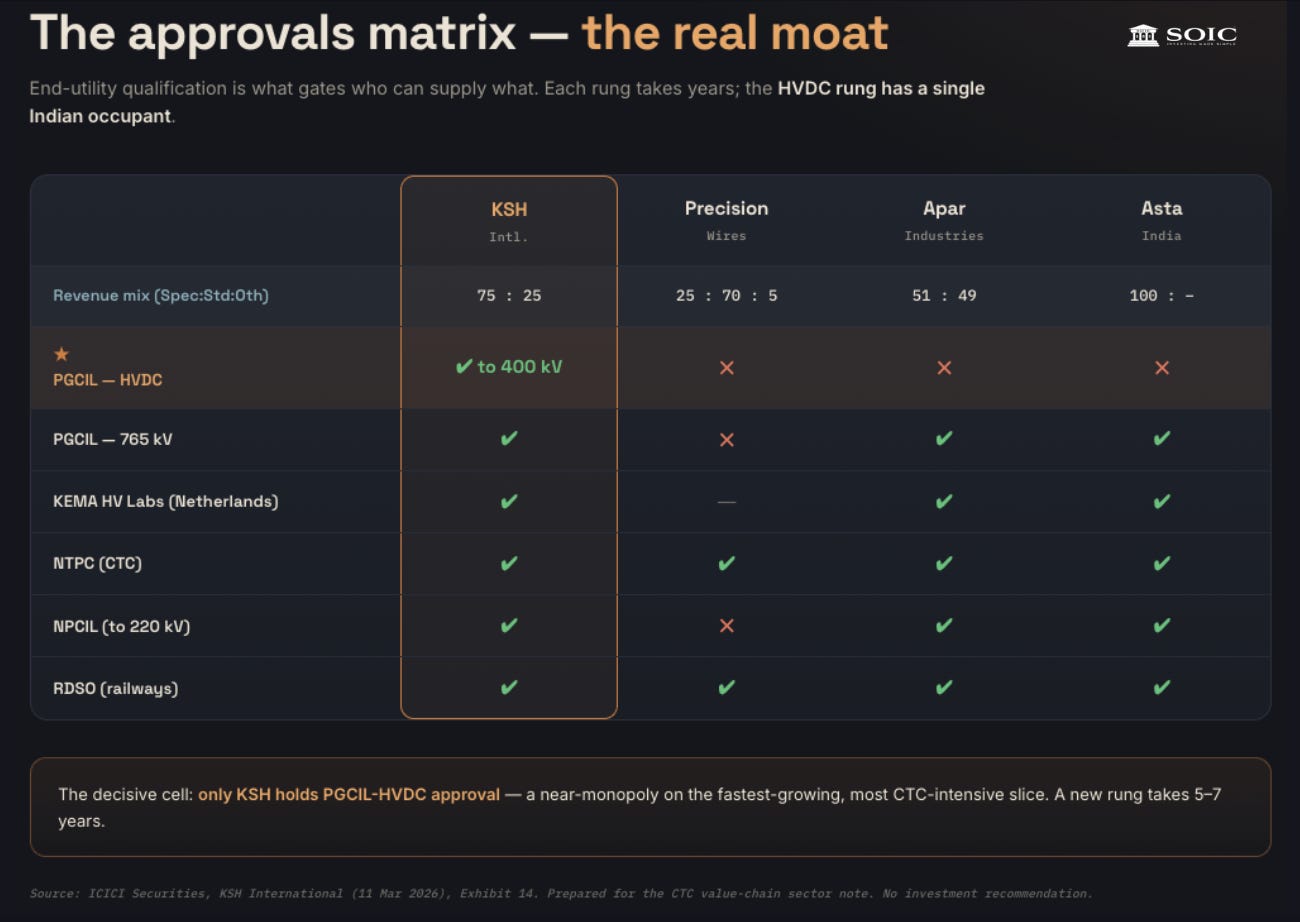
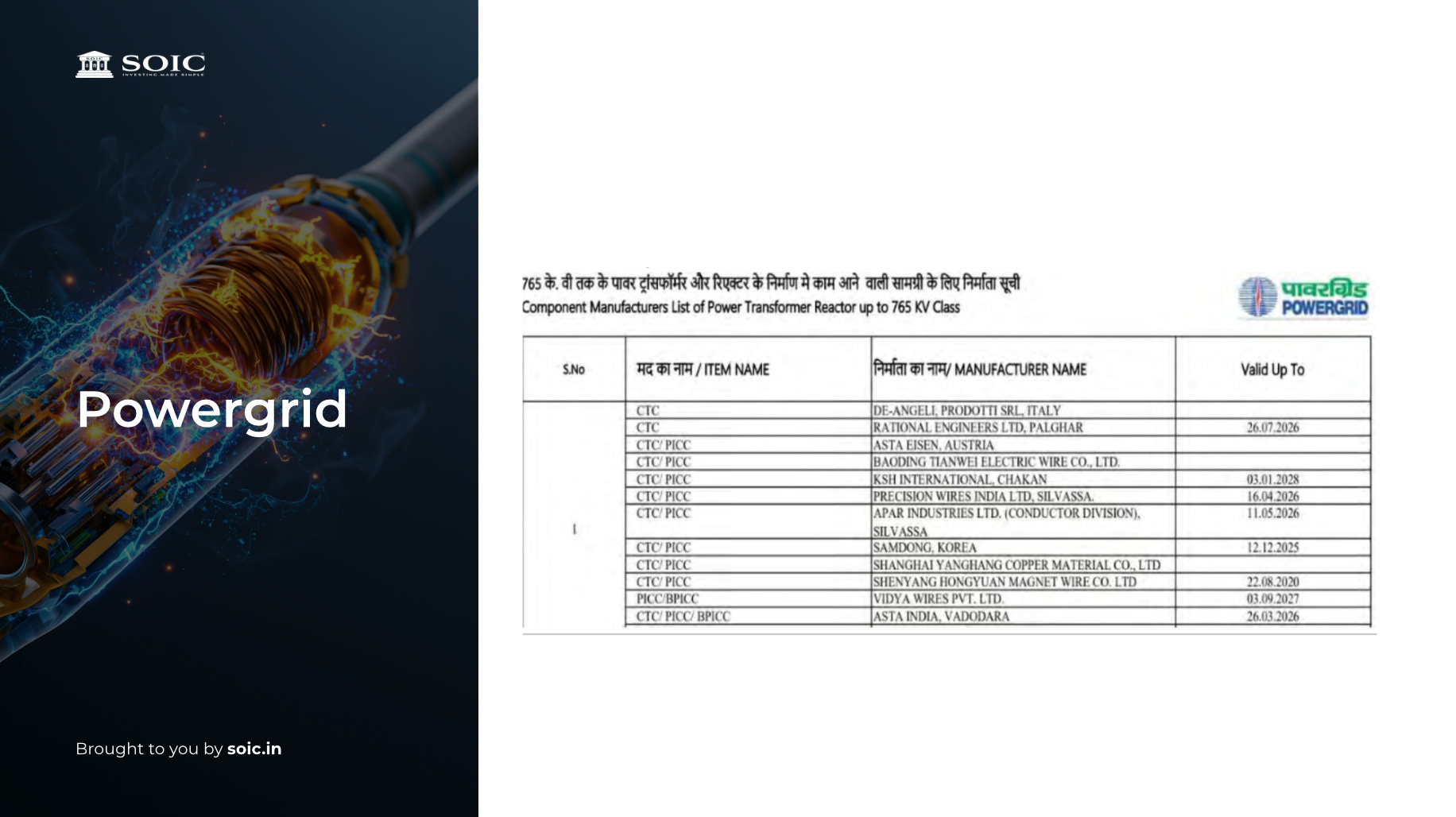
The single most valuable cell is KSH’s sole PGCIL-HVDC approval; no other Indian company is qualified to supply CTC for HVDC transformer windings. Given the 32.3 GW HVDC pipeline , this is a near-monopoly position on the most demanding, fastest-growing slice of the market. It is also independently corroborated from the demand side: Quality Power, needing HVDC CTC and finding only KSH makes it in India, has chosen to build its own captive HVDC-CTC line rather than depend on the market.
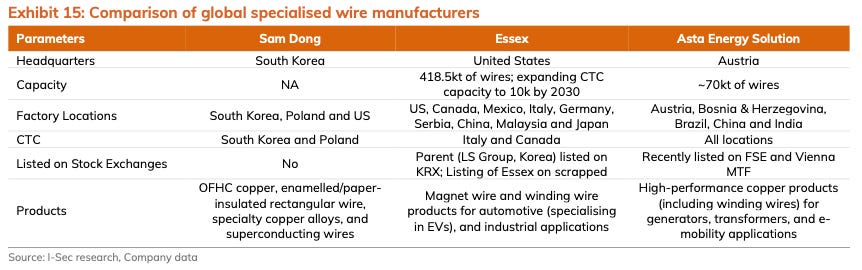
Cost-competitiveness underpins the export angle. KSH’s average CTC fabrication charge is estimated at ₹150,000-200,000/tonne, versus European makers (Asta Energy Solutions) at ₹500,000-600,000/tonne and Asta India at ₹300,000-350,000/tonne. Indian fabrication is structurally far cheaper than European. This is why the global transformer shortage translates into a real Indian export opportunity rather than just a domestic one.
The parallel bottlenecks - insulators, CRGO steel, bushings
Here is the crucial point most CTC analysis misses: the conductor is not the only chokepoint. The same transformer that needs CTC also needs insulators, grain-oriented electrical steel and bushings and all three are in acute shortage. A transformer maker held up by any one of them cannot ship, which backs up demand across the whole bill of materials, CTC included.
Insulators have an extremely severe shortage. Quality Power described insulator supply as constrained at just 80% of requirement, with prices up roughly 4x (from ~₹5,000 to ~₹20,000), suppliers now demanding 100% advance payment, and even China delivery taking 14 months. Though insulators are only ~1% of equipment cost, they block the invoicing of the other 99%. The company cited 200 crore of substation equipment made unshippable by ₹20,000 of missing insulator material. The shortage is expected to persist 3-4 years, aggravated by insulator factories outside India/China closing on pollution rules; Hitachi Energy and KEI are named as severely impacted too.
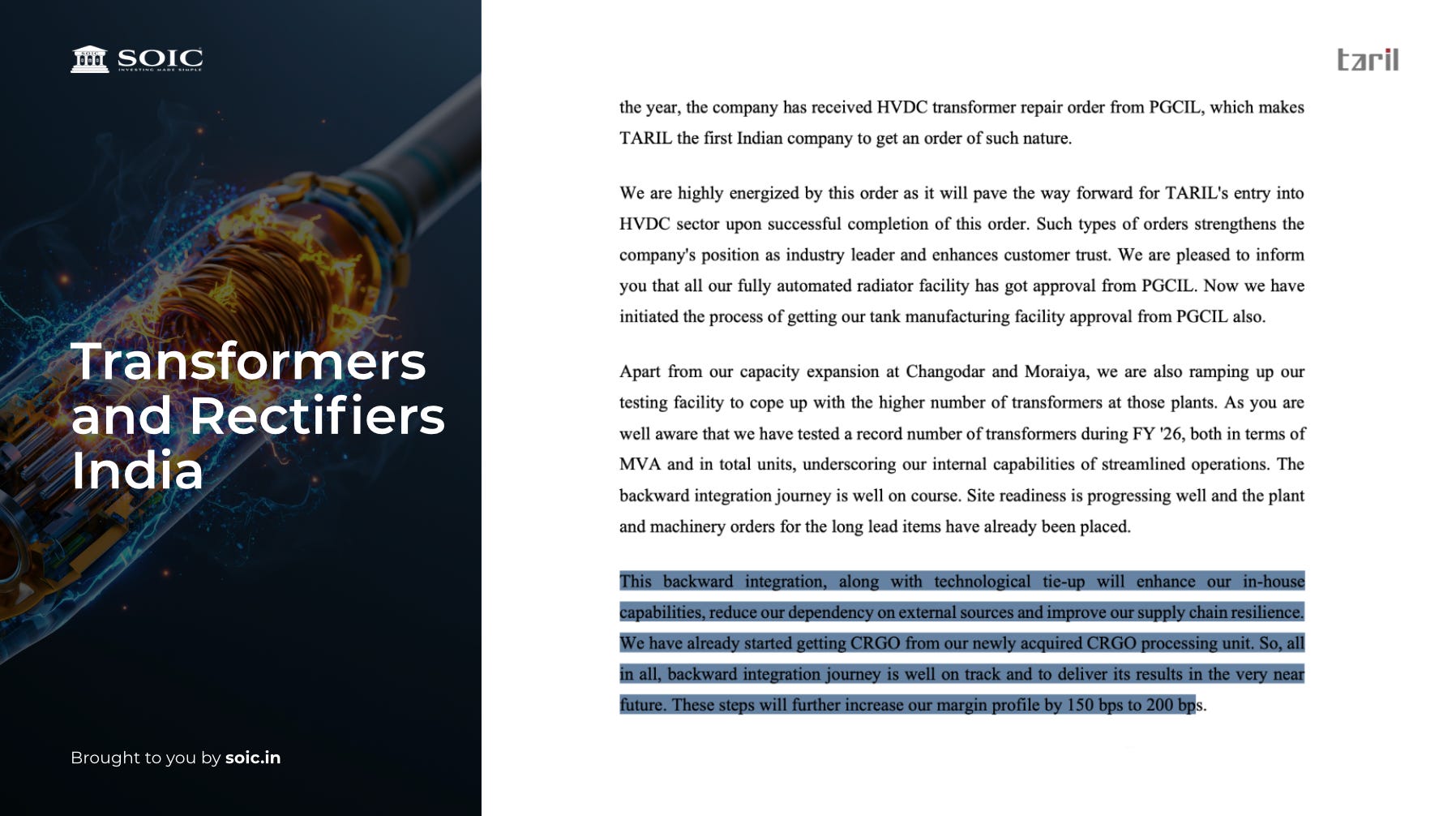
CRGO steel the core-material shortage. Cold-Rolled Grain-Oriented (CRGO) electrical steel is the transformer’s magnetic core, and India faces roughly a 30% shortage, per GTRI. Annual consumption is ~400,000-450,000 tonnes against domestic production of only ~40,000-50,000 tonnes ~90% is imported, mainly from China, Japan and South Korea. CRGO can be 30-35% of a power transformer’s cost. The situation is worsening: delayed BIS license renewals for foreign suppliers periodically block shipments, and on 22 June 2026 India’s DGTR launched a fresh anti-dumping investigation into CRGO imports from China, Japan, South Korea and Russia which GTRI warns may push transformer costs and put grid expansion at risk. Transformer OEMs manage this partly through captive/related-party sourcing (Atlanta gets 45-50% of its CRGO from a related party, Amod Stampings). But this part of the value chain we believe can go on and backward integrate into this part of the value chain as this does not involve that great of manufacturing complexity. Just like TARIL is backward integrating into this.
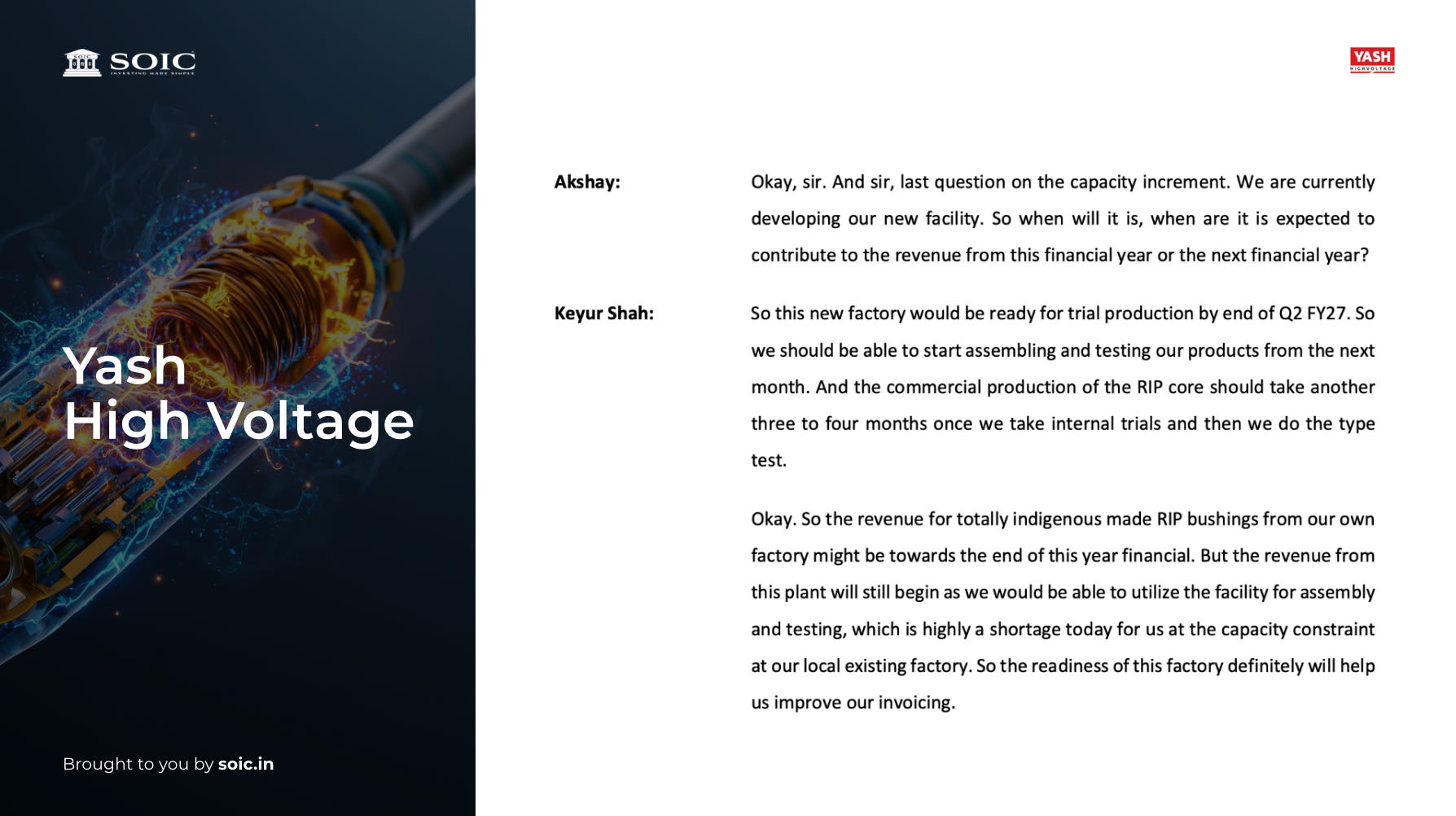
Bushings the delivery gate. Apar’s management explained that transformer OEMs “were not getting certain inputs like the bushings. As a result, their delays were happening… and therefore they were delaying some of the requirements of transformer oil and the CTC” a direct, named transmission of the bushing shortage into deferred CTC offtake. The government is now allowing imported (including Chinese) bushings to relieve the constraint, with domestic capacity expected to expand in ~6 months.
Transformer oil, too. Quality Power cited transformer-oil prices spiking from ₹81 to ₹175, an extreme cost increase that is a pass-through/margin issue rather than a windfall.
The qualification barrier as a system-wide bottleneck. Beyond raw materials, the vendor-approval process itself is a structural constraint on how fast supply can grow. A transformer OEM with capacity cannot simply switch CTC, CRGO, bushing or insulator suppliers without requalification, because PGCIL maintains approved-component lists and requires short-circuit and type testing from accredited labs.
Atlanta Electricals is a live example: it received PGCIL design approval for 400 kV-class transformers only on 1 April 2026, targets short-circuit test completion by 2QFY27 before it can even bid on 400 kV tenders, and is pursuing a European technology tie-up for 765 kV with bidding only from end-FY27.
This is the structural reason the capex cycle is extending rather than resolving: manufacturers “are increasingly focusing on higher voltage transformers, such as 400 kV and 765 kV, which involve longer manufacturing cycles and testing timelines. This has extended lead times”.
The synthesis of Part III’s first two sections: CTC is the marquee bottleneck, but it sits inside a stack of simultaneous shortages:- conductor, insulator, core steel, bushing each gated by multi-year qualification. This is why the transformer shortage is proving so durable, and why the derived demand for the qualified specialty inputs, CTC foremost, is so well underpinned.
Copper price dynamics and working capital is the constraint on growth
The final supply-side constraint is financial, and it is structural to this business model. Understanding it is essential to reading any CTC maker’s financials correctly.
The pass-through model. Copper is 85-90% of a CTC maker’s cost and is booked at the customer’s invoice price on the same day a make-to-order, back-to-back model in which the manufacturer earns its margin entirely on the fabrication spread, not on the metal.
Vidya’s MD: “we have a completely back to back pricing model… whatever price increase in the LME is there will be passed on to the customer… in absolute terms, our margins are quite intact, even if the prices of copper goes up”.
Bhagyanagar frames the same idea per-kilo: it targets a stable EBITDA/kg, so “if copper goes up 10%, my EBITDA/kg goes up ~10%” in rupee terms while the percentage margin optically compresses.
The valuation trap this creates. Because copper is pass-through, a rising copper price inflates reported revenue growth without any volume growth, a well-known trap for analysts of wire and cable companies, since the gross margin is a fabrication spread on top of a pass-through metal cost, not a percentage margin on the metal. The correct unit of analysis is therefore EBITDA per tonne (or per kg) and volume, not headline revenue or percentage margin.
On that measure the specialty players shine: KSH earned ~₹66,000/tonne EBITDA in 9M FY26 (up from ~₹50,000 a year earlier), and Bhagyanagar’s EBITDA/kg nearly doubled from ₹19.43 to ₹37.17 (9M FY25 → 9M FY26) as its value-added mix rose.
The working-capital bind. The same pass-through model, combined with an asymmetry in payment terms, produces a chronic cash-flow strain. CTC makers must often pay copper suppliers in advance (~5 days) while extending 30-45 day credit to transformer-OEM customers so a larger invoice value (whether from higher volume or higher copper price) locks up more working capital.
KSH runs 75-80 receivable/working-capital days versus peers’ 50-60, precisely because of this mismatch, though it is shifting toward credit-based copper procurement. The consequence shows up starkly in cash flows: KSH posted negative operating cash flow in both FY24 and FY25 despite growing profits (₹119 crore of working capital consumed in FY25 alone), and Bhagyanagar reported ~₹143 crore negative operating cash flow in FY25 with ₹179 crore locked in working capital, its current liabilities ballooning from ₹135 crore to ₹468 crore in a year. Quality Power generalised the point across the sub-sector: “Wire and cable companies showing higher revenues due to copper price increases are often facing bloated working capital and higher interest costs, not genuine profit growth”.
The copper price backdrop is itself elevated and volatile. LME copper hit record highs around US$13,800/tonne in late January 2026, and 2026 average-price forecasts cluster around US$11,400-12,600/tonne which is a large increase over 2025.
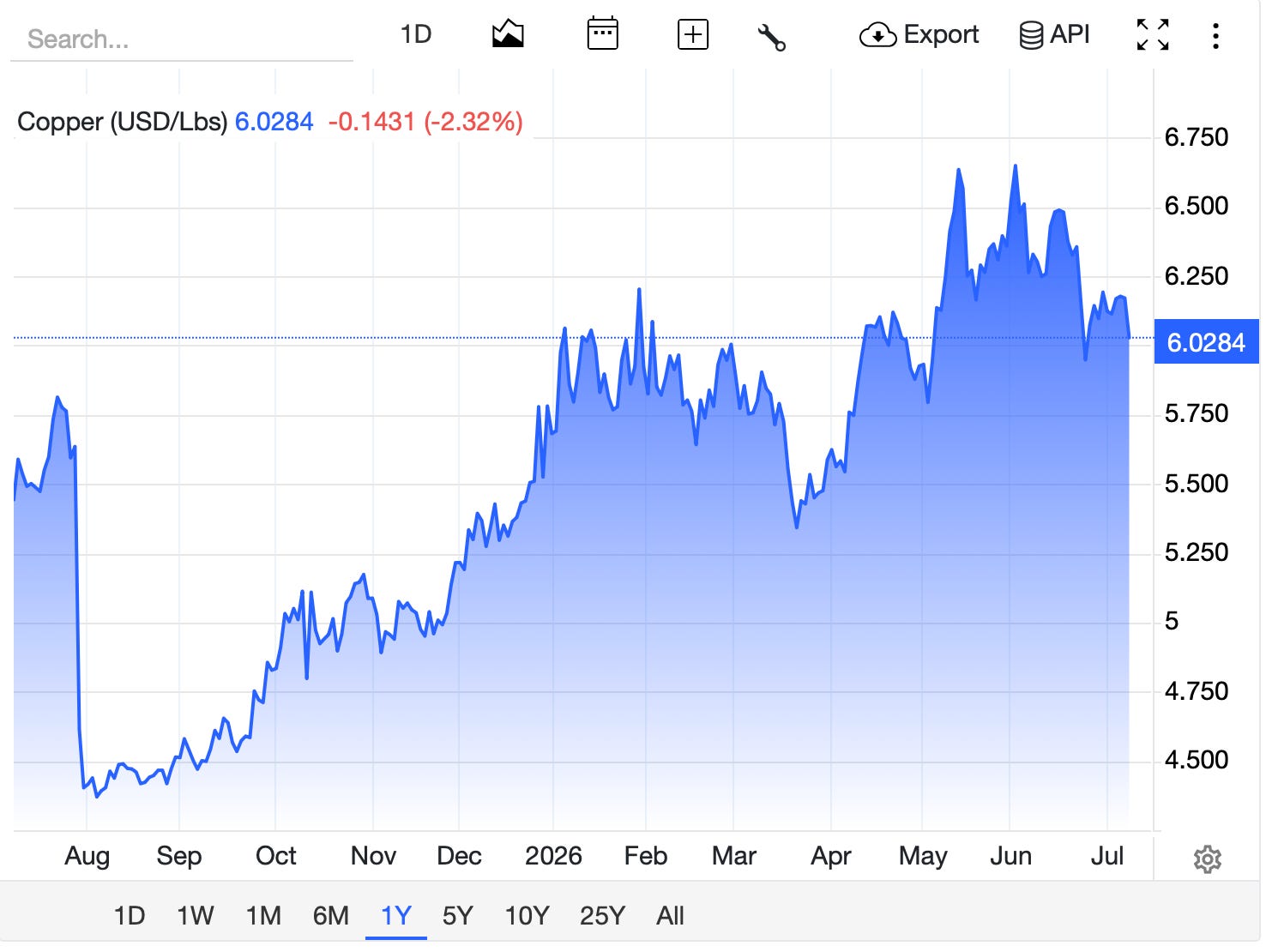
The longer-run structural picture is a market seen as broadly balanced through ~2028 before a significant structural supply deficit opens up, driven by peaking mine supply, deteriorating ore grades (0.95% in the early 2000s to 0.60% in 2024) and a stagnant project pipeline. For CTC makers this is double-edged: higher copper inflates working capital and margin optics, but the structural-deficit narrative also underpins the volume demand for copper-intensive grid and electrification equipment.
One partial hedge worth noting: export-oriented players with dollar revenue carry a natural offset when the dollar rises by 5%, steel and copper prices (in rupees) effectively fall by 5%, offsetting input cost pressures for dollar-revenue companies which is an advantage the export leaders (KSH, and the transformer OEMs) hold over purely domestic wire makers.
The bottom line of Part III: the CTC value chain is supply-constrained on three fronts at once a four-player qualified conductor base running near-full behind multi-year approval barriers; a stack of parallel input shortages (insulators, CRGO, bushings) gating the same transformers; and a working-capital-intensive financial model that limits how fast any single player can scale. Against the five demand engines of Part II, that is a structurally tight setup.
PART IV - THE PLAYERS
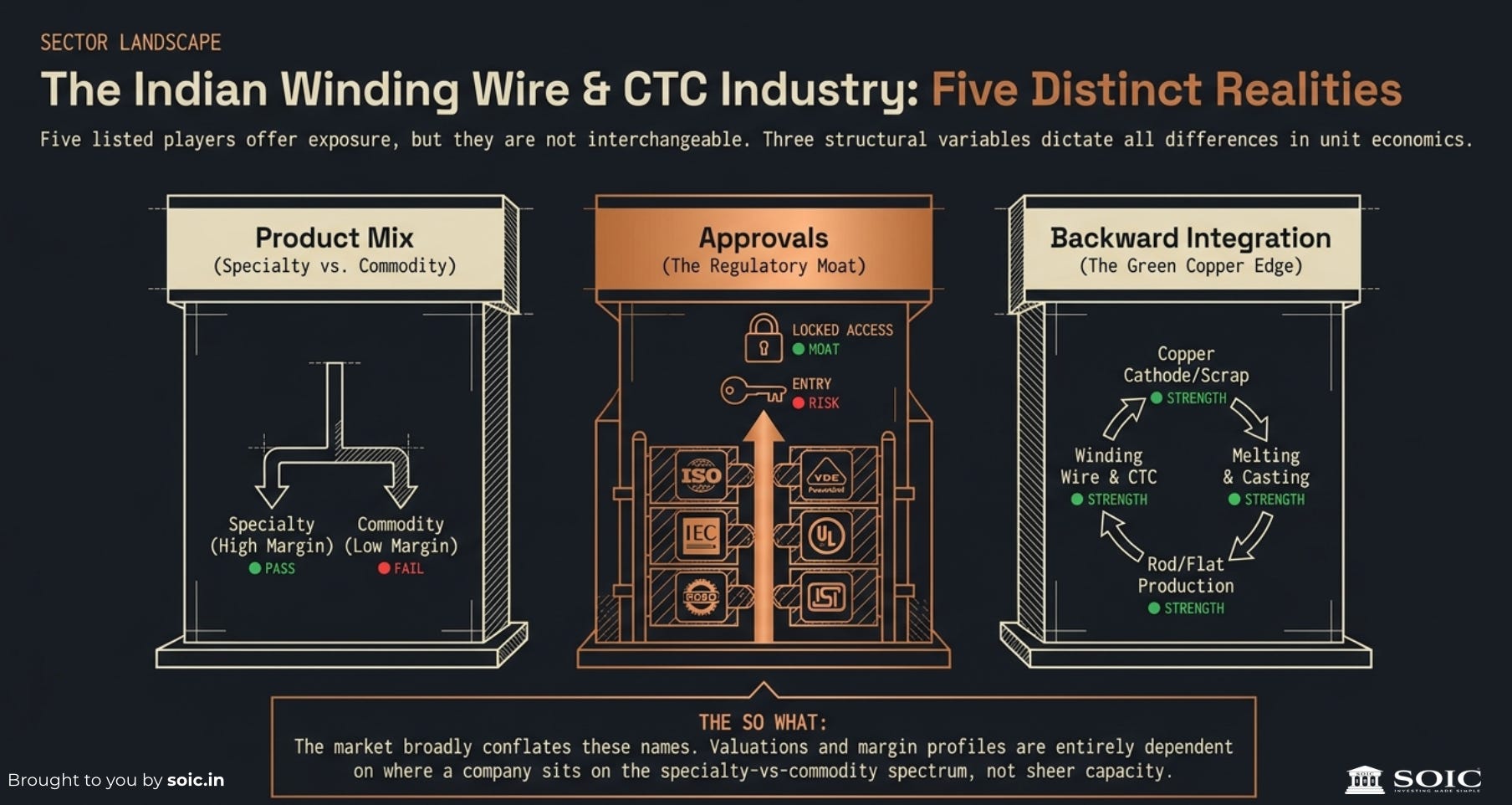
Five listed Indian names give investors and industry-watchers exposure to this value chain, and they are not interchangeable. They differ in where they sit on the specialty-vs-commodity spectrum, in their end-utility approvals, in their degree of backward integration, and in their balance-sheet quality. This part profiles each in depth. A recurring theme: the same three variables :- product mix, approvals, and backward integration explain most of the differences in unit economics.
Apar Industries - the scale leader with a transformer-oil flywheel
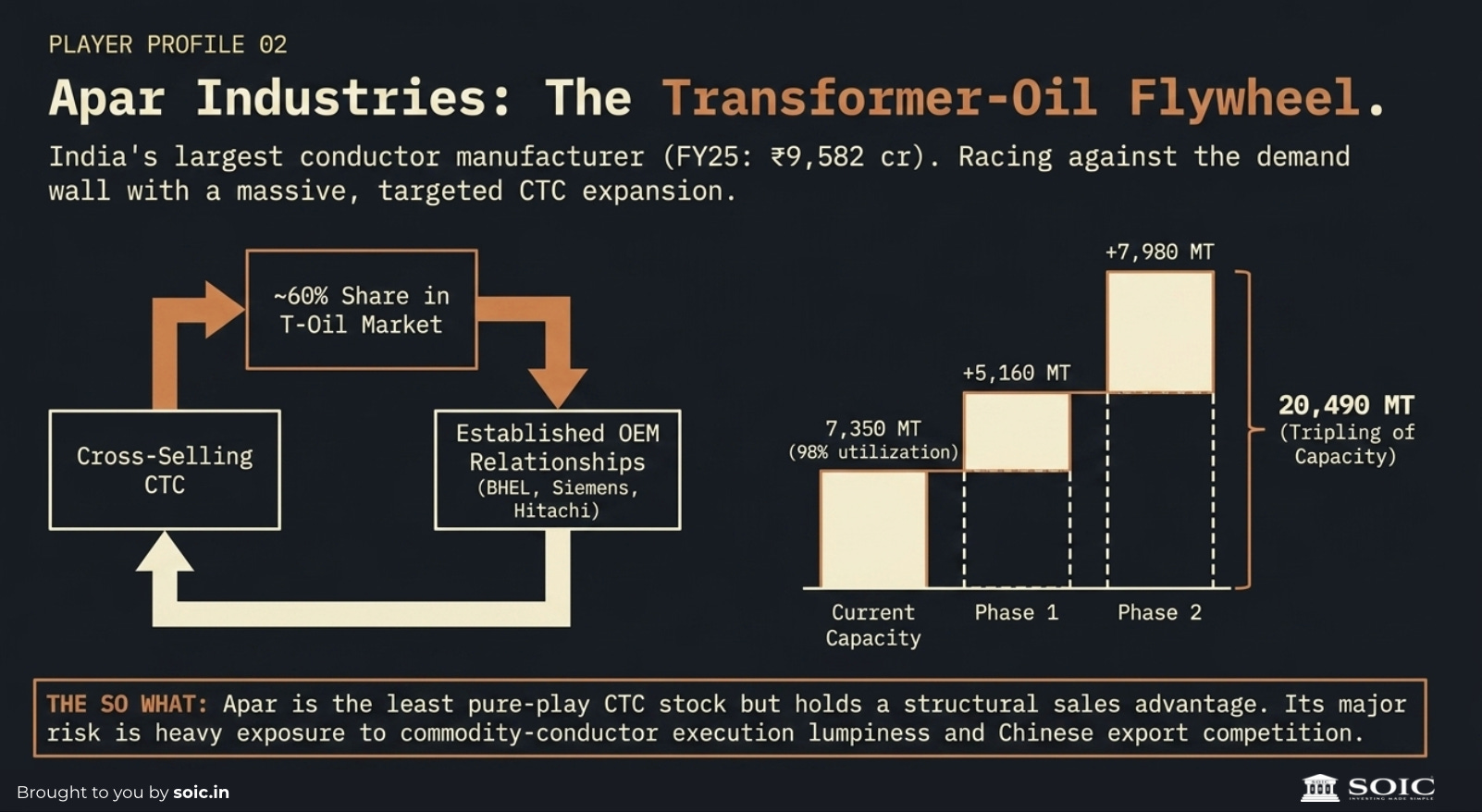
What it is. Apar is India’s largest conductor manufacturer and the largest exporter of conductors from India, a diversified group spanning four divisions :- Conductors, Specialty Oils & Lubricants, Cables, and Telecom with FY25 revenue of ~₹18,581 crore. The Conductors division alone did ₹9,582 crore in FY25, a 34.7% five-year CAGR. Within Conductors sit conventional and HTLS conductors, railway conductors, OPGW, specialty alloy rods, busbars, and the focus here CTC and PICC, which Apar describes as “enamelled strips widely used in transformers, generators and as winding material in the motor industry”. Apar launched CTC and PICC commercially in 2022.
Capacity and capex :- the CTC tripling. The most concrete Apar CTC datapoint comes from its November 2024 regulatory filing: existing CTC capacity of 7,350 MT/year running at 98% utilisation, being expanded in two phases (+5,160 MT, then +7,980 MT) to a total of 20,490 MT 3x of current levels by Q3 FY26, for a ₹72.55 crore investment funded via internal accrual/debt. This is the single clearest illustration in the whole sector of a qualified player at full utilisation racing to add multiples of capacity against the demand wall. Apar’s broader conductor+cable capex plan runs to ~₹1,400 crore, of which ~₹500 crore was completed by Q3 FY26, with the bulk expected by mid-FY27.
The transformer-oil flywheel. Apar’s structural edge in CTC is a customer base it already owns through transformer oil, where it holds ~60% share of Indian power transformers and is “the only Indian company to supply T Oil to all major HVDC projects in India”. As its conductor CEO put it: “as the customer base for transformer oil and CTC are the same, we strongly believe we will be able to synergise our leadership strength in the transformer oil segment to further expand the CTC business globally”. Few competitors have a pre-built relationship with every major transformer OEM to cross-sell CTC into.
Management on demand and bottlenecks. Apar’s commentary is a rich source on the whole sector’s demand-supply picture: on transmission, “60,260 megawatts of new substation capacity was added during the April to November time frame… approximately a 55% increase” but “only 75% of the planned additions”; on the bushing bottleneck delaying CTC offtake; and on demand durability, “the fundamental demand drivers continue to remain intact… carrying current business is going to only increase as the years come by”.
KSH International - the CTC pioneer and HVDC gatekeeper
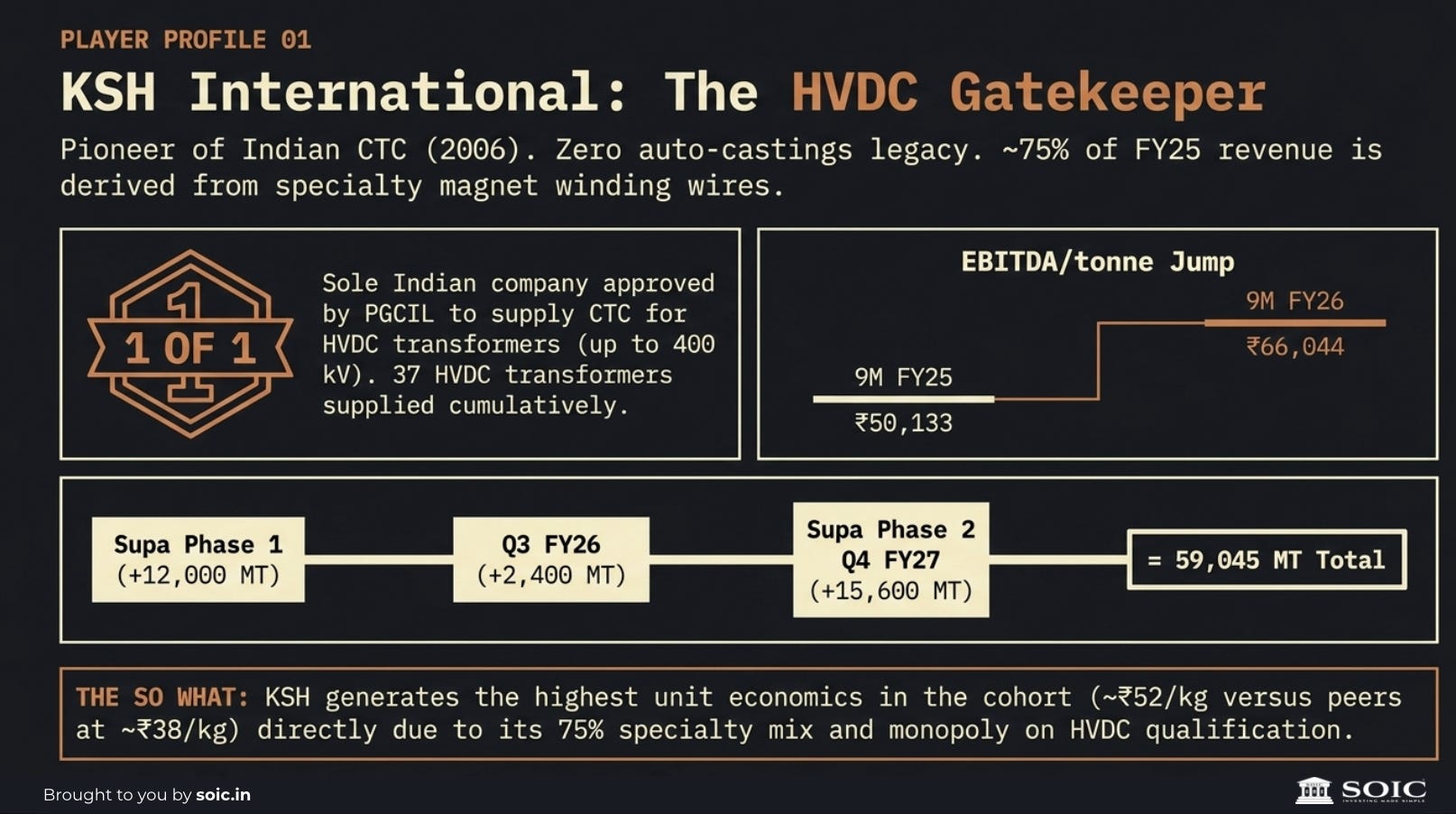
What it is (and what it is not). KSH is the company that “pioneered the indigenisation of Continuously Transposed Conductor (CTC) in India way back in 2006”, and after its December 2025 IPO, its management now describes it as India’s second-largest magnet-winding-wire manufacturer and the largest exporter of winding wires from India. An important correction to a common mischaracterisation: KSH is not a turnaround from an auto-component/aluminium-castings business. It was incorporated in 1979 (as Bhandary Metal Extrusion), began commercial production of PICC in 1981, and has made magnet winding wire ever since; its only real pivot was expanding from specialty into standard round wires in FY22 for EV traction motors and appliances a product-line extension within the same business, not a diversification away from castings. It is part of the wider Hegde-family KSH Group (which also includes KSH Infra and KSH Logistics), with promoter holding of ~74.6% and zero pledge.
Product mix the profitability engine. KSH splits into Specialized Magnet Winding Wires (CTC, PICC, bunched paper-insulated wires for HVDC/765 kV transformers, traction, wind generators) at ~75% of FY25 revenue, and Standard Magnet Winding Wires (round enamelled) at ~25%. Roughly “75% of our revenue comes from large power transformers and medium power transformers… driven by our core product… CTC”. The specialty tilt is why KSH’s unit economics lead the pack (below).
Capacity and capex. KSH is doubling capacity from 43,445 MT (as of Dec 2025) to 59,045 MT by end-FY27 via its new Supa (Ahilyanagar) plant. The build history: Supa Phase 1 (12,000 MT) completed Sep 2025, +2,400 MT more in Q3 FY26 to reach 43,445 MT, and Phase 2 (~15,600 MT) targeted for Q4 FY27. Total Supa capex is ~₹340 crore across both phases (₹220 crore Phase 1 + ₹120 crore Phase 2, the latter including a ₹100 million copper-recycling line). Post-IPO, KSH repaid ~₹226 crore of debt, cutting debt-to-equity from 1.35x to 0.42x by Dec 2025 [KSH Q3 FY26 transcript, pg. 6].
Unit economics best-in-class. KSH earned an EBITDA/tonne of ~₹66,044 in 9M FY26 (up 32% from ₹50,133 a year earlier), with a 6.5% EBITDA margin. FY26 revenue reached ₹3,107 crore (+61% YoY) on 28,168 MT of volume (+21%), with PAT of ₹110 crore. Its EBITDA/tonne comfortably exceeds commodity-leaning peers a direct function of its specialty mix.
The moat: sole HVDC qualification. KSH is the only Indian company approved by PGCIL to supply CTC for HVDC transformers (up to 400 kV), on top of NTPC, NPCIL, RDSO and KEMA approvals. It has begun supplying specialty wire for 37 HVDC transformers cumulatively (11 from a BHEL order for the Bhadla-Khavda consortium, 26 from another customer). Its customer roster reads like a who’s-who of transformer OEMs: BHEL, Hitachi Energy, GE Vernova, Siemens, Toshiba, CG Power, Bharat Bijlee, Transformers & Rectifiers, plus global names:- 5 of its top 10 customers have been with it over 10 years, the oldest ~40 years. It exports to 24 countries, “exclusively to transformer companies”.
Backward integration and new products. KSH’s “green copper” upcast-rod initiative (Section 4) targets ₹2,000-3,000/tonne of EBITDA uplift from FY27-28, and its exclusive HPW Metallwerk license positions it for the 800V EV-motor PEEK-wire opportunity.
Management on the thesis. KSH’s MD gives the clearest articulation of the whole sector thesis: “The primary bottleneck is the supply of power transformers, which is driving capacity expansion by transformer OEMs globally… This directly feeds into the demand for our products”; and on HVDC as the prize: “one of the most exciting opportunities in our view lies with HVDC, which is required to evacuate power over long distances for renewable energy projects”.
Precision Wires India - the winding-wire volume leader, a partial CTC player
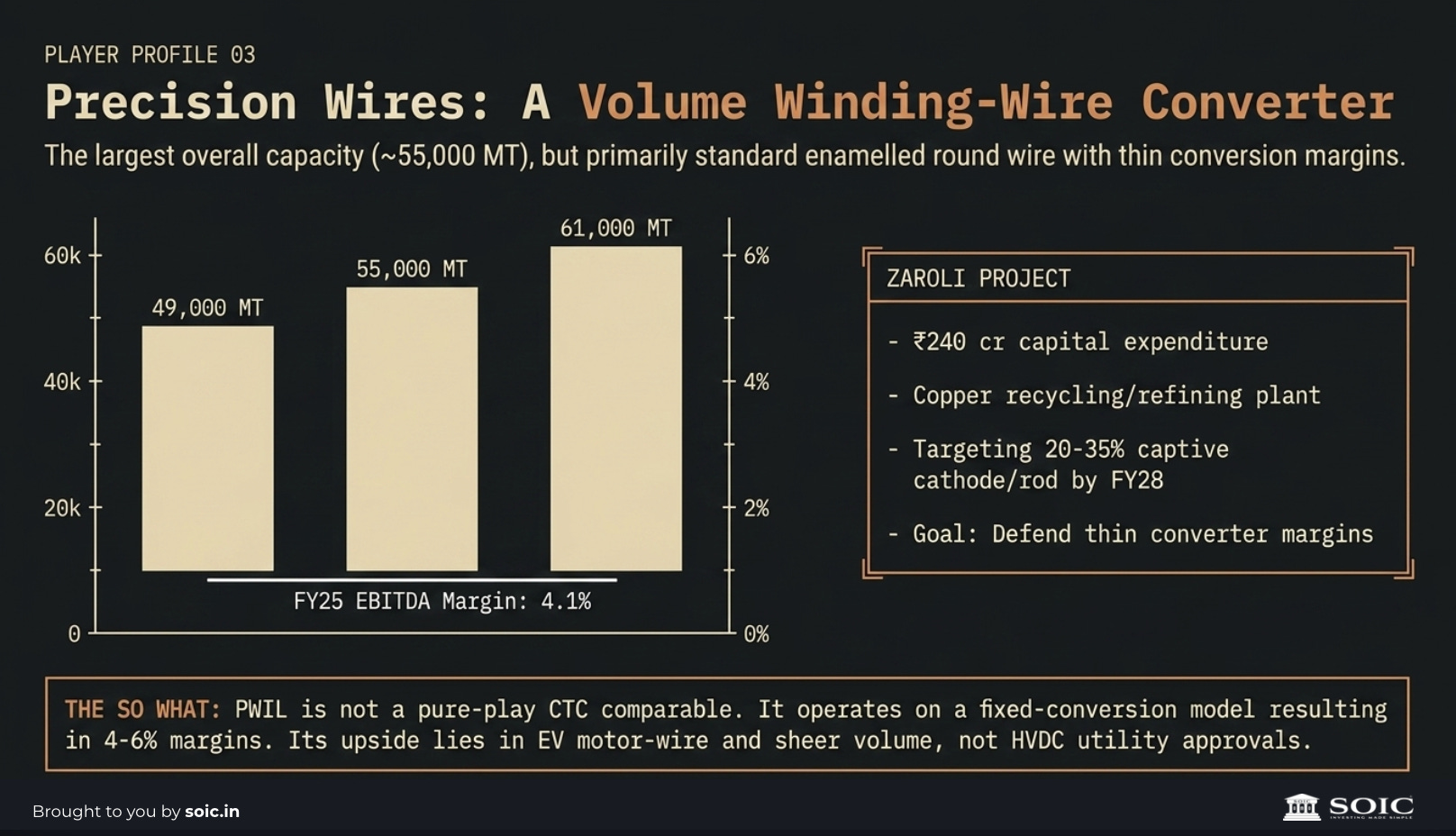
What it is. Precision Wires India (PWIL) is India’s largest winding-wire producer by capacity (~55,000 MT/year as of mid-2025, expanding to ~61,000 MT by June 2026). It operates primarily as an enamelled copper winding-wire company; its CTC (PRECITRANS, 5-72 strands) and PICC lines are bundled within an unquantified “high-teens %” value-added revenue bucket and not disclosed standalone. PWIL is a scale leader in winding wire and an adjacent or partial participant in CTC, rather than a pure-play comparable like Apar or KSH.
Economics. Due to its commodity-focused mix dominated by round enamelled wire, PWIL operates with thin structural margins, with PBILDT margins around 4%-6% as a converter charging fixed conversion charges. Its FY25 EBITDA margin was ~4.1%. This volume-heavy but thin per-unit economic profile stands as the mirror image of specialty-heavy competitors like KSH.
Capacity and Backward Integration. Operating plants at Silvassa and Palej (Gujarat), PWIL’s capacity path progresses from ~49,000 MT (FY24) to 55,000 MT, then ~61,000 MT by June 2026, and toward 74,000-82,000 MT by FY30. Its key strategic move is a ₹240 crore copper recycling/refining plant at Zaroli (Gujarat) to produce 99.99% cathode and rod for captive use, targeting 20-35% of its raw material needs by FY28 and funded 60:40 via debt and internal accruals. Total three-year capex is guided at ~₹300 crore, placing PWIL in the “green copper” backward-integration camp alongside Bhagyanagar and Vidya.
Customers, Markets, and Revenue. PWIL supplies OEMs in power, auto, consumer durables, and transformers, counting CG Power, Lucas TVS, Highly Electrical Appliances, and Mitsuba India as clients, with exports at ~12% of sales. FY25 revenue reached ~₹4,030 crore (+22% YoY) with ~12% volume growth and 89% utilisation. Approvals from global AC-compressor makers and leading EV/hybrid manufacturers position it for the EV motor-wire ramp, riding sector demand drivers like transmission, distribution, renewables, railways, data centers, and EVs (which see a 2-3x increase in copper winding wire content).
Competitive Position. In the specialty and CTC approvals matrix, PWIL is the weakest of the four scale players, holding NTPC (CTC) and RDSO approvals but lacking PGCIL HVDC, PGCIL 765 kV, and NPCIL approvals. It appears on Power Grid’s approved list for PICC/BPICC instead of CTC, making its PRECITRANS CTC line a minor contributor. Consequently, its competitive relevance centers on volume winding wire, the emerging EV motor-wire market, and Zaroli integration rather than high-voltage CTC.
PWIL faces thin converter-level margins, fragmented unorganized competition using lower-purity copper, copper price (90% of cost) and forex volatility, and high working-capital intensity after a sharp FY25 rise in inventory and receivables. Execution and leverage risks on the Zaroli capex are key monitorables, with CARE noting it will moderate debt coverage metrics over the short-to-medium term.
Vidya Wires - the fast-scaling CTC entrant
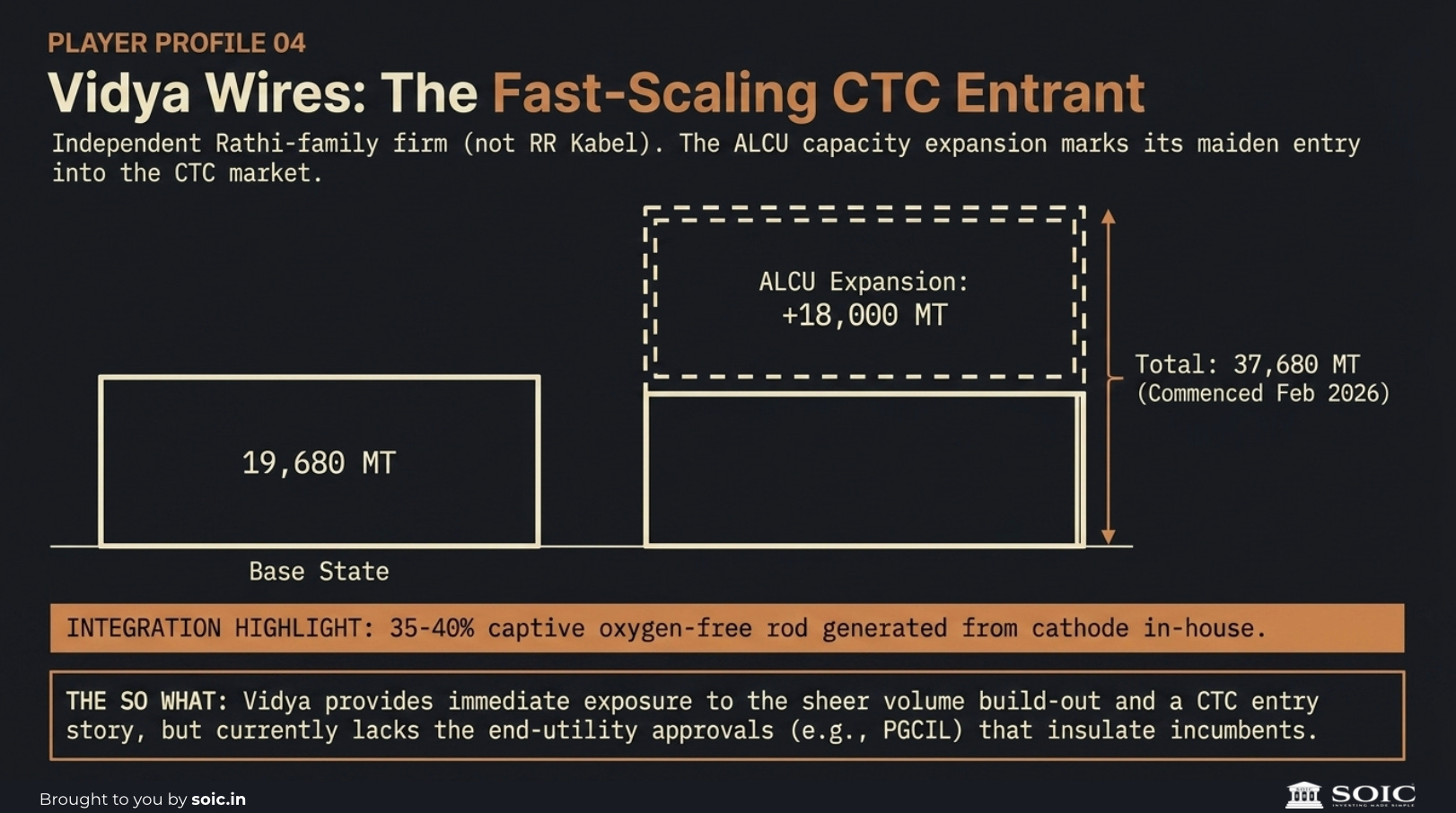
What it is. Vidya Wires is an independent, Rathi-family-promoted winding-wire manufacturer from Anand, Gujarat, incorporated in 1981 and IPO’d in November 2024 (separate from the RR Kabel group). It is India’s 4th-largest player with a ~5.7% market share, producing over 8,500 SKUs across 12 product categories, expanding soon to 18–20.
Capacity and CTC Entry. Funded by IPO proceeds (~₹140 crore to capex and ~₹100 crore to debt repayment), its subsidiary ALCU Industries (Narsanda, Gujarat) is doubling capacity from 19,680 to 37,680 MTPA, with commercial production having commenced in February 2026. This expansion marks Vidya’s entry into CTC and specialty products, aiming to lift its market share to ~11% (3rd position).
Backward Integration. Vidya manufactures 35–40% of its copper rod requirement in-house as oxygen-free rod using cathodes sourced from Vedanta, Union Copper Rod, and Marubeni, securing a cost and quality advantage.
Economics and Demand. In FY25, revenue reached ₹1,486 crore (+25% YoY), EBITDA was ₹64 crore (4.3% margin), and PAT grew 59% to ₹41 crore. Profitability per tonne is projected to improve as higher-margin segments scale to support massive power sector investments and generation capacity goals.
Bhagyanagar India - recycled/green-copper backward integration
Bhagyanagar India (BIL) is a 40-year-old, Hyderabad-based copper recycler and fabricator operated by the Surana family at a 60-acre Toopran facility. BIL sources copper scrap globally, refines it to 99.9% purity, and casts its own rod, running on only 10-15% virgin copper. It fabricates rods, strips, bus bars, foils, enamelled wires, and transformer conductors (CTC/PICC) for ~500 OEM customers across electrical, transformer, automotive, solar, switchgear, and AI data-centre verticals. The copper business, held via subsidiary Bhagyanagar Copper Pvt Ltd, is undergoing a demerger into a new entity, Tieramet Ltd, to separate it from residual real-estate and wind assets.
In its CTC segment, BIL operates two 29-strand lines and a newly commissioned larger machine, guiding output toward ~150 tonnes for 50+ power transformer customers, which is projected to contribute ~₹30 crore+ of EBITDA (~20% of total) at peak utilisation. Shifting aggressively to value-added products (from 39.6% of revenue in FY24 to ~60% in Q3 FY26) lifted EBITDA/kg from ₹19.43 to ₹37.17 between 9M FY25 and 9M FY26. A key new niche is silver-plated copper bus bars for AI data centers, which secured a 106 MT (~US$1.33 million) maiden export order with 3-4x expected order growth; BIL is India’s only producer of copper bus bars up to 300 mm wide.
Conclusion - the story underneath the story
Strip away the noise and the picture is clean. India is committing on the order of ₹9 trillion to rebuild and expand its transmission grid over a decade, while the world faces a multi-year transformer shortage that imports 80% of in the US alone. Every large transformer in that build-out for a solar zone in Rajasthan, a data center in Maharashtra, or a utility in Texas needs Continuously Transposed Conductor in its windings.
Yet that conductor is made at scale by only four qualified Indian players, whose combined specialty capacity is inching from ~45 kt to ~77 kt, from plants already running at 85-97% utilisation, guarded by five-to-seven-year qualification barriers, and hemmed in further by parallel shortages of insulators, core steel and bushings. Only one of them can make HVDC-grade CTC. And the whole cohort is straining against a working-capital-intensive model in a copper-deficit country that imports 90%+ of its refined metal.
That is the demand-supply gap. The transformer supercycle is the headline; the CTC bottleneck is the story underneath it narrower, less understood, and arguably more constrained. The players who will matter most are the ones who clear the qualification barriers (above all HVDC), integrate backward into greener and cheaper copper, and the acid test convert announced nameplate into utilised, cash-generating, value-added tonnes. Watch those three things, and you are watching the real sector.
Also one other key thing to watch will be how fast this demand supply gap will be there as the supply from China will also open up in India with the recent regulation change.
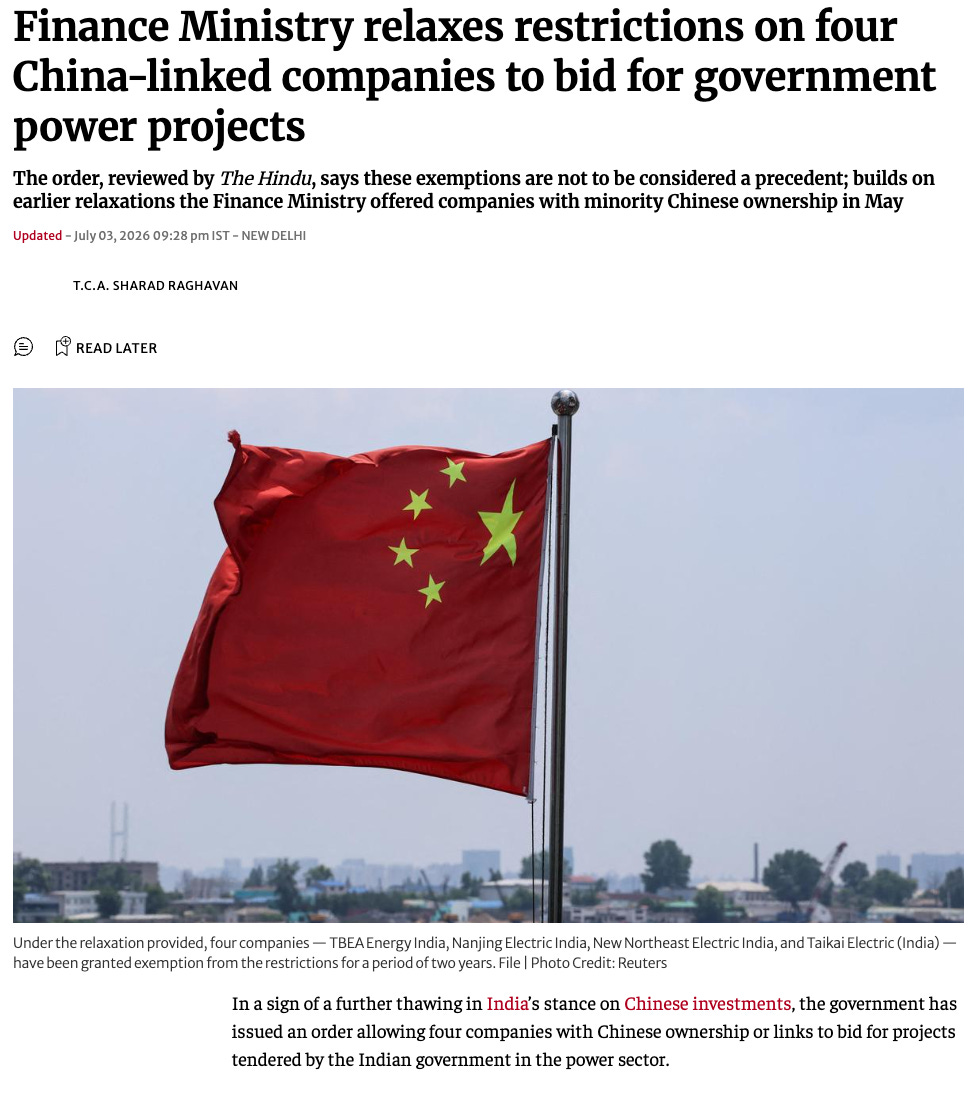
Watch the tailwinds, capex ramp up and the risks we talked about if you are tracking this space and you are largely sorted.
Great knowledge,thanks🙏
Wow !! A detailed Anslysis with great clarity. Thanks for the post.
Always a great fan of SOIC